Showing posts with label prize winning author. Show all posts

17 February 2018

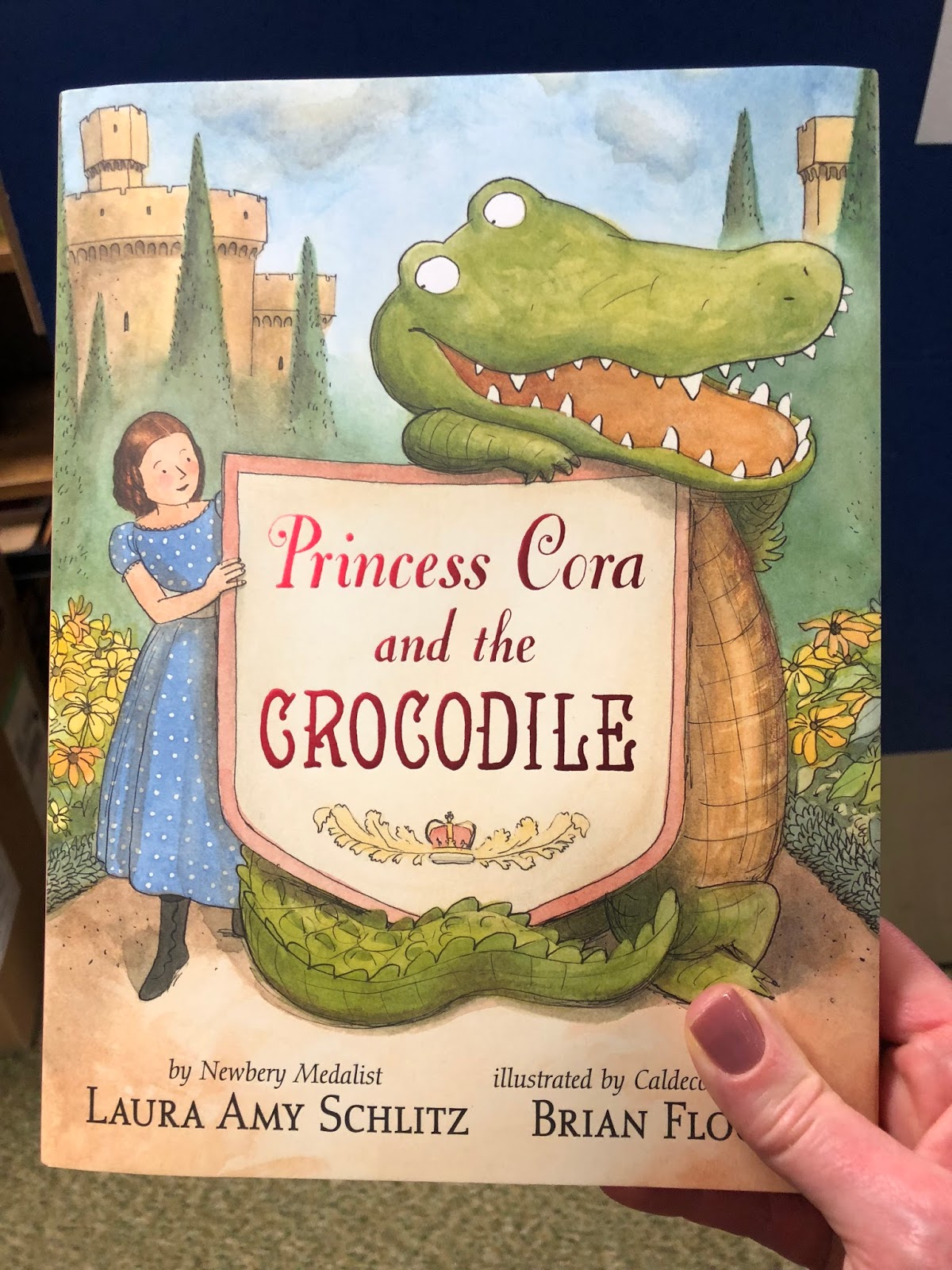
Princess Cora and the Crocodile

Princess Cora and the Crocodile
Laura Amy Schlitz
Illustrated by Brian Floca
Candlewick Press

Princess Cora is overwhelmed.  Her parents love her so much and want her to be successful, so they fill her day with the things that are most important to being an excellent princess and queen - taking baths (a queen must be tidy), studying (a queen must be intelligent) and physical activity (a queen must be strong).  Cora often tries to suggest to them that they're over doing it, but they don't listen.  One day, Cora has had enough and she writes her fairy godmother a letter, asking for help in the form of a pet.  Cora wants a dog, but her fairy godmother has other plans.  She sends Cora a crocodile, and a naughty crocodile at that.  Hilarity ensues, and eventually (after a little gnawing from a crocodile dressed like a princess) the king, the queen and the nanny all realized that Cora does need a bit of a break.
This is a great book with a kind of sad twist to it.  At first, none of the adults even notice that it's not Cora but a crocodile - they are all to wrapped up in "worrying what might be wrong with her". And every minute of every day is planned around training for Cora by the time she is seven years old.  I enjoyed the story when I first read it for it's absurdity and silliness, but as I think about it more, I can't help but see some parallels in the way we currently raise and educate our children.
Are Schlitz and Floca trying to subtly tell us something?  I recently read an article about the life lessons found in Chinese children's literature vs. children's literature in the United States, and it got me thinking about how what we read shapes our beliefs and thoughts.  I can't help but wonder who will benefit more from reading this book - children who might learn that it's OK to play and to ask adults for what we need, or adults who might need to be reminded that kids need to be kids.
In any case, the book is absolutely worth the time for readers of any age.


27 January 2018

The Journey of Little Charlie by Christopher Paul Curtis

The Journey of Little Charlie
Christopher Paul Curtis
Scholastic Press
Release Date: Jan. 30, 2018
order it from the Tattered Cover here

My favorite book of all time is The Book Thief by Markus Zusak because it was the first book I'd ever read that gave the German perspective of the Nazis during WWII .  It opened my eyes and I connected very quickly with the idea that not everyone who lived in Germany (in fact a very small number of Germans) actually sympathized with the ideals of the Third Reich.
I know, it's a weird way to start a book review by talking about how much I loved another book...but stick with me.  Christopher Paul Curtis has done the same thing with The Journey of Little Charlie.  Told from the point of view of the not-so-little Little Charlie Bobo, this is the story of slave catchers in the 1850s who would travel north to try and recover escaped slaves.  The story opens with the sudden death of Little Charlie's father and the discovery that his father apparently owed money to a man named Cap'n Buck.  Cap'n Buck says that the only way Charlie can pay off his father's debt is by helping him recover "stolen property".  Little Charlie has never left his home of Possom Moan, South Carolina and though he's tall and looks like a full grown man, he's only 13. Along the way Little Charlie discovers the true character of Cap'n Buck and though he doubts he should be helping the Cap'n at all, he sees no other way proceed.
This would be a great book to use when teaching character evolution - the changes in Little Charlie are both obvious and inferred, which is perfect for upper elementary literary analysis.
I also learned to love the way the book was written.  Curtis writes it the way that Little Charlie would say it (much like the Aibileen Clark chapters from The Help). I struggled at first because I was reading it from a teacher's point of view and I wasn't sure how well students would be able to read it and understand what he was saying.  However, by the middle of the book, I was used to it and loved Little Charlie's voice, and I think students will too.  It would make a great read aloud if the reader was willing to get completely into it.
I would highly recommend this book to teachers and students and plan to give it to a student who loved Elijah of Buxton on Monday and see what she thinks of it.

Once again, thank you to Kristen Gilligan of the Tattered Cover for providing me with awesome ARCs to read and review.

05 September 2013

Chomp

Chomp
by Carl Hiaasen
Alfred A. Knopf
2012

I've loved Carl Hiaasen since I read the very first page of Skinny Dip (read it, you'll agree).  I love his sarcastic wit and well-woven plot lines.  When I became a teacher librarian and found out he also writes books for young readers, I was excited and nervous.  Not many writers can write well for multiple ages (case in point: LOVE James Patterson books for young readers, can't stomach his adult novels).  However, Hiaasen nails it.

Chop stars two fantastic young people: Wahoo and and Tuna.  The only two kids on the planet named for fish (granted, Wahoo isn't named for the fish - he's named for a professional wrestler).  Wahoo's dad is a wild animal wrangler.  Tuna's dad is...not so great.  When Wahoo's dad is hired to help out with a survival show Expedition Survival, Tuna decides to tag along, especially since the host of the show - the famous Derek Badger - is her personal hero.  Tuna quickly finds out that Derek Badger (who is referred to not-so-affectionately by Wahoo's dad as "Mr. Beaver") is not the survivalist he claims to be on the show.  And when Badger goes a little crazy and wants to start doing all his own stunts, things get messy quick.  Wahoo and his dad can't back out of the job - they need the money, and Tuna doesn't want to go home, so they're stuck trying to make the best of a difficult situation.

As always, Hiaasen's dry humor and plot twists turn the book from just another book to an absolute page turner.  And I appreciate the fact that the relationship between Wahoo and Tuna never turns romantic - it would have been too cliche.  Wahoo's love for his family and his animals, and his desire to help Tuna are genuine and completely age appropriate.  And Hiaasen's portrayal of adults is also age appropriate: they are flawed but not to the point of being disrespectful.

I would highly recommend this book to anyone who thinks Bear Gryls is a bit much.  Ok, seriously, I would recommend this book to any one who likes survival stories (both wilderness survival and tough-life-situation survival), any middle-grade student looking for a fun read, and any parent who wants a great book through which they can connect with their child.

30 August 2013

Spy School

Spy School
by Stuart Gibbs
Simon & Schuster Books for Young Readers
 2012

I picked up Spy School for two reasons.  First, it is  a Colorado Children's Book Award Nominee this year, and second, a student checked it out last week and came in two days later saying "Ohmygosh, Mrs.Covington this book is AMAZING howhaveyounotreadityet?!?!"

I didn't have an answer, and I didn't have a book to read that night, so I took it home. And I'm glad I did!  It's a great read - just enough suspense to keep me reading, along with some truly humorous moments.

Ben Ripley is a 12-year-old dork.  There's no two ways about it.  When he comes home from school one day to find out he's being recruited for the undercover CIA spy school, he's overjoyed.  Finally, he'll be able to do something cool.  Unfortunately, it's all top secret - he can't even tell his best friend.  However during his first day at spy school, after being shot at a few times and fighting off an attacker in his dorm room with a tennis racket, he finds out that he actually didn't qualify for spy school - they brought him in to use as a decoy to flush out a mole within the school.  Luckily for the CIA, Ben is actually smarter than he seems and he turns out to be a pretty good agent-in-training, especially since his life is on the line.

While the plot is extremely fantastic, and I was a little annoyed with how absolutely inept every single adult in the book was portrayed, Spy School is a fun read.  And though I'll admit I figured out who the mole was before the book actually revealed it, I will say it took some re-reading and deep thinking for me to actually figure it out.  I would say this book is a great read for anyone between 4th and 7th grade - depending on their reading level, and it's a great read for any kid who likes spy novels.

23 October 2012

Geek Fest...I mean CALCon 2012

I say "Geek Fest" with the utmost respect for my fellow librarians.  I realize that ninety percent of all professional conferences come with their own level of "geekness" - librarians speak a different language than, say, surgeons and accountants.  And when large groups of accountants, surgeons or any other profession get together, they tend to speak their own language and get REALLY excited about things that are only exciting to their particular professional area.  I imagine that at an accounting conference, people discuss tax laws heatedly, and at surgical conferences there is a buzz and excitement about the newest piece of surgical technology.

For me, the Colorado Association of Libraries 2012 Conference (CALCon) was especially geek-tastic.  Not because of the other conference attendees, but because of two of the keynote speakers.  I completely and utterly geeked out when I was able to meet one of my favorite bloggers and one of my favorite authors.

Jack Gantos has been publishing books since 1976.  He writes picture books, children's books, YA lit and adult books.  He's funny, quirky and smart.  He's like the Johnny Cash of the literary world - minus the scary mean side.  His novel, Dead End in Norvelt won the Newberry Award last year, and it is fantastic - funny, inspiring and meaningful.  I can't think of a single student who wouldn't love this book.
See?  We're bffs.
He spoke on Saturday and it was inspiring.  He talked about how he writes, what inspires him and why librarians are important.  I laughed so hard I almost peed.  But most of all, I loved hearing him speak because he brought a voice to the main character from Dead End - Jack.  In fact, I didn't realize it until I heard him speak, but Dead End is his childhood (with some wonderful twists).

Explaining how "librarians are like constellations"

Gantos also does school visits where he teaches creative writing.  He explained that writing really isn't that difficult.  There are two steps:  figuring out what you want to say it, and then figuring out how to actually say it.  However, since most students can stare at a blank piece of paper and just wish the words would appear, he often encourages them to draw a spy map of their house.
The spy map of the Gantos home
Drawing a map of the house from the perspective of a spy encourages students to open up their imaginations and think of all the possibilities for interesting, fun stories.

Gantos saved all the journals he's written since 5th grade - and he explained that many of the ideas for his books come from things he wrote in his journals over the years.

The other person I had the honor of meeting and hearing speak (twice) was Bobbi Newman.  She's a firecracker - and not just because of her hair.  She truly is a library innovator: she maintains a blog called Librarian By Day that always tackles and faces big library issues (intellectual freedom, access, the changing face of libraries), and she has a great voice.  She's funny and inspiring.  I'm a huge fan.

My library hero
Newman gave a keynote speech as well as lead a breakout session.  Her keynote speech tackled the idea that innovation might be scary and uncomfortable but it's necessary for libraries to maintain relevance within a community.  I enjoyed her keynote speech, but I loved her breakout session.  There she discussed the importance of digital literacy and transliteracy, and the myth of the digital native.  All of which are extremely important to libraries, librarians and anyone who works with the internet.  At least they should be...

Completely enthralled
So you can see, a three day conference turned into a totally library-world-celebrity-geekfest for me.  I also got to spend three days with two of my very favorite librarians:  my best friend from childhood Sarah and one of my mentors, super librarian Becky.  These two women inspire me daily, and I'm so thankful I got to hang out with them, learn with them and be inspired by them.

Now let's see if I can apply all the fantastic information and ideas to my everyday library world.

24 September 2012

Emory's Gift by W. Bruce Cameron

Emory's Gift
W. Bruce Cameron
Forge
2011

If you happen to be one of the four people who know me and have not had to listen to me go on and on about the amazingness (it's a word) of A Dog's Purpose, then stop reading this post and read this one and then come back here.
If you aren't in the mood to blog surf, I'll just spit it out for you:  W. Bruce Cameron has written a book that changed my life.  I am a dog lover (not an animal lover necessarily, but definitely dogs) and A Dog's Purpose changed the way I view the mortality of the dogs I've loved in my life and why I keep the stinky little mutts around.
While at the library a few weeks ago, I decided to look for other books by Mr. Cameron, and that's how I came across Emory's Gift.
While the two books are very different, Cameron has a distinctive writing style that is enjoyable to read, and he definitely has a knack for plot twists.
Emory's Gift is about a thirteen year old, Charlie, and a grizzly bear, Emory.  Charlie's life hasn't exactly been a walk in the park - his mother recently died of cancer and his father is struggling to keep it together.  When you add the fact that he's in middle school, well, you can imagine how much life just sucks.  One day while fishing in the stream behind his house, Charlie not only sees a grizzly bear, he pretty much feeds the bear the trout he'd caught.  A few days later the bear writes the name Emory in the sand, and Charlie realizes that this bear is special, but he wants to keep Emory a secret.  Eventually, it is clear that Emory doesn't want to be kept a secret, and Charlie and Emory embark on an unbelievable adventure.
By the end of the book I could not read fast enough and could not put it down.  Cameron weaves a beautiful tale of adolescence, family and growing up in a small town.  However the ending? Meh.  Don't get me wrong, it wasn't bad - it was actually quite good.  I was just expecting something more moving - the ending of A Dog's Purpose stuck with me long after I finished the book.
All in all, Emory's Gift is a great read - definitely something to pick up before going on vacation or a great read for a rainy weekend.  Unline ADP, I don't think it's necessarily an all-ages book.  It's more violent and I'm pretty sure it has a few four letter words.  I'd recommend it for middle school and older, and to anyone who loves the outdoors and the idea that the unimaginable is possible.

Happy Reading!
S

14 April 2012

Mirror Mirror by Marilyn Singer

Mirror Mirror
Illustrated by Josée Masse
Dutton Children's Books
New York
2010

Funny story behind me reading this book. See, since last fall I’ve fallen in love with the Cybils awards (mostly because I aspire to be a judge someday...), and I’ve  slooowly been working my way through the winners.  Many of the young adult books I’d read, so I kind of skipped those and headed for the elementary books – they’re the group of books I usually don’t get around to.  So where’s the funny part?  I accidentally bookmarked the 2010 winners in the elementary category.  So I’ve slooooly worked my way through LAST YEAR’S winners.  You’d think someone as “techno-saavy” as me wouldn’t make such a mistake.  But you’d be wrong.  Either that, or I’m not as “techno-saavy” as everyone thinks.  Anyway, I’m especially thankful that I made this mistake because I’ve found some really great early reading books!  One of those books is one that I haven’t been able to get out of my head for weeks.  It’s called Mirror Mirror.  The inside cover reads:
Ther are two sides to every story, from the princess and the frog, to the beauty and the beast, to Sleeping Beauty and that charming prince.
Now in a unique collection of reversible verse, classic fairy tales are turned on their heads.  Literally. Read these clever poems from top to bottom.  Then reverse the lines and read from bottom to top to give these well-loved stories a delicious new spin.

Isn’t that a fantastic idea?  The author calls these reversible verse poems reverso.  I wasn’t sure how it would work, but once I read one, it all made sense.  Here’s what one of the poems looks like:

It may be such
a fairy-tale secret,
this much
I know:
The road leads
wherever
you need to go.

When you reverse it, it looks like this:

You need to go
wherever
the road leads –
I know
this much.
A fairy-tale secret?
It may be such.

Isn’t that fantastic!?!?  The illustrations are also fantastic – each illustration is split in half and matches each side of the reverso.

Who would I recommend this book to?  Uh, just about anyone.  And I totally understand why it won…last year.  Now I’m off to find this year’s winner!

28 February 2012

Paper Covers Rock

Jenny Hubbard
Delacorte Press
2011

Most people think that I’m super smart because I’m a librarian.  Completely untrue.  I’m really not that smart, and in reading Paper Covers Rock, I realized that I know nothing about classic literature.  Nothing. Zip. The amount in my bank account. Nichts.
Paper Covers Rock is written in diary form, and it is the diary of Alex Stromm, a student at a boarding school in North Carolina.  One afternoon in the fall, he witnesses one of his best friends die in a terrible swimming accident.  In an attempt to deal come to terms with his grief and feelings of guilt, Alex starts keeping a journal; one that is partly reflective in nature and one that tells the story of what happened the day Thomas died.   What keeps the book moving is the fact that Alex isn’t exactly sure what happened that day at the rock – he knows that he, Thomas and their friend Glenn had been drinking, and Thomas had been drinking the most of all of them.  He knows that they decided to jump from the rock into the river, and that he and Thomas played Rock, Paper, Scissors to see who would jump first.  And he knows that when he surfaces from his dive, Thomas is unconscious, and shortly thereafter, he’s dead.  The school has a very strict no alcohol policy, so Glenn and Alex must cover up some of their story in order to stay in school, and Alex quickly begins to suspect that Glenn is trying to cover up more than just the incident on the rock.
So what does all of this have to do with classic literature?  Alex has a bit of a crush on one of his teachers, Miss Dovecott, and in trying to help Alex deal with his loss, she recommends that he read different classics: Moby Dick, the Old Man and the Sea, etc.,  and he weaves lots of literary references into his diary.  For example, he refers to himself as Is-Male (I got that one), and he asks Her-Mann lots of questions (got that one too), and apparently the title to each chapter is a quote from Moby Dick (missed that one).  While I was reading I could tell when the narrator was referencing something, but I rarely had the background knowledge to make the connection.
Regardless of being able to make connections, Hubbard did an amazing job of creating a realistic voice in Alex Stromm.  I don’t know for sure, because, well, I’m not and have never been a teenaged boy, but Alex’s guilt and uncertainty are absolutely real and palpable. And the ending is absolutely true to life.
I wouldn’t necessarily recommend this book for middle school or reluctant readers because of all the literary references (I’d call them obscure, but they probably aren’t).  However, I think that just about any high school student can relate to Alex because everyone, at some point, has to choose between seeing the truth even though it’s painful and difficult, or continue to turn a blind eye because it’s easier.  And everyone, at some point in their lives, goes through an event that will change their existence permanently.

10 February 2012

Shiver by Maggie Stiefvater

Shiver
Scholastic Press
2009
Two apologies to start off this review:

1.  I'm WAY behind the times in reading this book.  And for that, I'm sorry.

2.  Dear Maggie Stiefvater:  I'm sorry I read this book when I did.  I know you've written a great novel (er, trilogy), and I should have read this book years ago.  Any book that followed the high of Daughter was bound to get a meh reaction. That’s just the way things are. But I'm still a little sorry.

With Shiver Stiefvater has taken the “forbidden love” plotline and threw a big, rather hairy, wrench into it. Grace and Sam have always admired one another, but from afar.   Grace has always admired Sam from her kitchen window, and Sam admired Grace when she came into the bookstore where he worked during the summer.  So why don’t the two just talk to each other?  Because Sam isn’t a typical teenager: he’s a werewolf.  When the weather gets cold enough, he turns into a wolf and stays that way until the weather warms enough that he can turn back into a human.  In their small town of Mercy Falls, MN, there has been lots of wolf activity recently – a student was mauled and killed by the wolves.  When a hunting party shoots Sam, he is able to turn himself into a human and luckily Grace is there to save him.  Finally united in their human form, Sam and Grace make the best of the time they have together while trying to find a cure AND save the town from Jack, the oh-wait-he-didn’t-actually-die new werewolf in town.
Being a non-fan (antifan?) of the romance genre for the most part, I thought I was destined to dislike this book.  It sounded Jacob-gets-Bella-esque from the description, so I was leery.  However, the super creative twist (think Ladyhawke only sans Ferris Bueller, and for teenagers) made it completely readable to us Nicholas-Sparks-loathers.  I will say that the plot dragged a little for me, and there were times when Grace and Sam were gazing deep into one another’s eyes and I kind of hoped for a wolf to jump out and bite them, but again, I blame the timing.  I’m pretty sure if I’d read this book in the fall, or even six months from now, things would be different.  But I digress.  In general, it was a pretty good read.  I can absolutely see the teen attraction, and the last chapter or so hooked me.  I would love to say I’m going to read the rest of the trilogy: Linger and Forever, but unfortunately, I just don’t have time.  The pile of books-to-be-read grows daily, so I rarely read sequels (Laini Taylor, if you’re reading this, that sentence does NOT apply to your books.  Just sayin).
Regardless of whether or not I find out what happens to Grace, Sam, and all the other great characters from Mercy Falls, I would highly recommend (and already have, twice) this book to just about any teenage girl who loved Twilight.

31 January 2012

The actual review for Daughter of Smoke and Bone

The Daughter of Smoke and Bone
Little Brown
2011

Ok, so yesterday’s post was kinda mean.  Well, not mean, but it wasn’t really a review as much as it was a demanding rant.
Sorry about that.
But The Daughter of Smoke and Bone is one of the best books I’ve read in a while.  Holy crap it’s good.  It’s so good that when it ended, I didn’t pick up another book for three days because I couldn’t imagine reading anything else.  And in my world, not picking up a book for three days is a big deal.  HUGE.  My guy was a little worried when I was reading magazines and…gasp…talking to him instead of ignoring him (in my defense, he likes to read as well and is rarely offended when I ignore him).
Every time I give the premise of Daughter, people look at me like I’m nuts.  It’s so involved and so intricate it can be a little confusing.  So stick with me for a minute mmkay?
17 year old Karou lives a double life in Prague.  On the one hand she’s an extremely talented art student who doesn’t have a family and is a little mysterious. On the other hand she’s an errand girl for the chimaera (mythical beings made up of different animals and human parts) who raised her.  However, because they are part animal, part human, the chimaera do not venture out into the human world.  Karou must access them through a one-way portal: she knocks on a door and it is opened to her.  If she tries to open the door from the outside, she cannot enter.  Brimstone, the head chimaera, is a Wishmonger – if you bring him things he wants, he pays in wishes.  And usually what he wants are teeth.  Karou is usually sent out to collect teeth from all kinds of people, both normal and…well…unsavory.  Upon returning from an errand, Karou notices a handprint has been seared into the door of the portal. About a week later, she is attacked by a seraph – a super hot angel dude.  Shortly thereafter, all the portals burn down and Karou is left alone in the human world.  As she tries desperately to find a way back to the only family she’s ever known, the seraph – Akiva – reappears in her life, and Karou is drawn to him for completely inexplicable reasons.
And that? Is only about a third of the actual plot.  The plot is amazing – twists and turns and creativity I never would have imagined. The world Taylor creates is mystical and fantastic and so completely believable you will get lost in it.  And not lost as in “ohmygoodness where am I”, lost as in “I have animals to feed and a job to do? Pah.  I shall read and nothing else”.
And on the last page, you will simultaneously want to hug and curse Taylor.  Hug her because she has created this amazing work of fiction that is romance, action, fantasy wrapped together with a little comedy, and curse her because the sequel Days of Blood and Starlight  (the title was just announced Friday on Taylor’s blog) isn’t due out until this fall.  Oh, the horror.  I seriously don’t know if I can wait that long.  I’ve already contacted Taylor and begged for an advanced copy.
And yes, I will be sending her a link to this review in the hopes that she finds me witty and charming and sends me an advanced copy.
If not, you can bet your knickers I WILL NOT work immediately following the release of Days of Blood and Starlight. I will be reading and neglecting the rest of my life for at least 24 hours.
I also just noticed on her blog that Universal already owns the film rights.  There are only 52 days left until Hunger Games the movie is released.  And you all know how excited I am about that right?  NO LIE: I’d trade Hunger for Daughter.  THAT’S HOW AWESOME IT IS.
So go read it. Now.

30 January 2012

The Daughter of Smoke and Bone by Laini Taylor

The Daughter of Smoke and Bone
Laini Taylor
Little Brown
2011

There are about a thousand ways I could/can start this review. But I feel like this one sums it up the best:
Stop what you are doing RIGHT NOW and go check out Daughter of Smoke and Bone and read it.
RIGHT. NOW.
Why, dear friend are you still reading this review?!?! Were the capital letters not urgent enough?  Did I not make myself clear?
Go.
Now.
I swear, you’ll love this book and be completely annoyed that the sequel isn’t due out for another six months.
Now go.
JUST GO ALREADY.
Sheesh.

Updated:  I felt bad about this review, so here's the for realsies review 

16 December 2011

Trapped by Michael Northrop

Trapped
Michael Northrop
Scholastic Press
2011
It’s winter, it’s cold, and it snows.  Luckily where I live, it doesn’t snow too much (yes, I live in Colorado, but newsflash, the western side of Colorado is the desert), so we rarely get snow days (darn).  When I lived in Chicago I always hoped for snow days, but in the four years I lived there, it just never happened. As a teacher, I love snow days.  It’s the greatest feeling in the world – wake up, start getting ready for school and ring ring YES no school!  I’ve never thought about the fact that a snow day could be bad.
Then I read Trapped by Michael Northrup and I realized a snow day could be bad. Especially if it meant I’d be stuck at school on a snow day.
Trapped takes place in New England – a place where monster snow storms are more common.  And the storm that takes place in this book is the big one – the perfect snowstorm. The book starts out and it’s a regular day with snow expected.  When the snow starts to fall harder and sooner than expected, school is released a little early so the students can get home.  Of course, a few students and a teacher stay late – grading papers, working on projects, etc.  By the time they decide to leave a few hours later, the snow is so bad, cars are no longer driving on the road and it looks like they’ll be stuck overnight. The next morning they wake up and it’s still snowing and it doesn’t look like it’s going to stop.  They realize that no one is going to be coming for them anytime soon, so they make themselves comfortable – they raid the cafeteria for food and try to make the best of it.  But when day three and four pass and the snow hasn’t stopped, no power and no sign of help coming, things get interesting.
I enjoyed the premise of the book, and I really enjoyed that it was told from a student’s point of view – for the first day or so, they aren’t worried because they’re at the age where they still rely on adults to take care of them.  Once there are no adults to make the decisions, things get a little tricky.  The characters are relatively true to “typical teenagers” – though I must say, they were pretty tame for teenagers.  I liked this book, but it wasn’t really a page turner, and my reliable student reader Anna called it “a little kid-ish”.  It has action, it has suspense, but it’s just a little…vanilla.  Having said that, I liked that it wasn’t over-sensationalized – it’s definitely realistic fiction.
Though it didn’t make my top ten list of greatest books ever written in the history of the world, I would recommend it to some of the readers I have who don’t like fiction because it’s “fake”.  I think those readers who enjoy reading books that are realistic and not dramatized at all would enjoy a book like this.

05 December 2011

A Monster Calls by Patrick Ness

A Monster Calls
Patrick Ness
(inspired by an idea from Siobhan Dowd)
Candlewick Press
2011
First off, let me say that usually, I don’t do scary.  I’m the girl that has night terrors and is truly afraid of things that go bump in the night.  When I do read scary books, I usually only read them during daylight hours, and they usually have a pretty profound effect on me – especially on my ability to sleep.  When A Monster Calls came across my desk, I knew the book would have an effect on me, I just didn’t realize how much of an effect.  And…spoiler alert…it’s actually NOT scary.
A Monster Calls is about Connor, whose father has moved to America and has a whole new family, whose grandmother is hard-working and pretty cold toward him, and whose mother is battling cancer.  Connor has suffered from a terrible nightmare for months – his mother falling off a cliff being consumed by a monster.  When another monster appears at his window one night, he isn’t scared.  This monster has not come for his mother, it’s come for him.  The monster will tell Connor three tales, and then Connor must tell him a tale – the only truth Connor knows.  But Connor isn’t sure he can tell the only truth he knows.
Throughout the book Connor tries to convince himself that the monster is just a dream – I mean really, it’s a talking tree!  But as his mother gets worse, and things at school get worse, the monster continues to visit him, tell him stories and have a profound effect on him.
I don’t want to tell you much about the book, because I think part of the reason it affected me as much as it did is because I didn’t know much about the storyline.  I will say that the book really isn’t about monsters.  It’s about coping with grief and loss.  Patrick Ness has done a superb job of creating a new way of viewing the human condition and what is “unfair” in life.
What I will tell you about the book is that while it was written by Ness, the idea came from another great writer – Siobhan Dowd. She has written several excellent novels which I can’t keep on my shelf, and in 2007 she lost her battle with breast cancer.  Last night as I finished the book, I couldn’t help but think about her and her battle.  Did this idea come from her difficulty in dealing with her mortality?  I also kept thinking about a conversation I recently had with my dear friend Katy– is it easier to deal with loss when it’s sudden or when it is a slow process?  In the end, we realized that loss is difficult regardless of when and how it happens, but the most important part of loss is dealing with it.  I hope I never have to deal with loss similar to Connor’s (I’m hoping beyond all hope that my parents are actually immortal…), I’ve learned a lesson from Connor’s story – speaking the truth is the only way to truly deal with loss.
I would recommend this book to just about anyone – unless they’re looking for a traditional “horror” book.  The illustrations (by Jim Kay) are haunting, but the book really isn’t about monsters in the traditional sense.  This book really is about as close to realistic fiction without actually being realistic fiction as humanly possible.  This book is heart-wrenching, deep and thoughtful.  So if you’re looking for funny, don’t pick this one up.  But if you want a book that will make you think about truth, the human condition and the tough stuff in life, I highly, highly recommend this book.  And yes, I cried (shocker).

Here's an article/review written by Jessica Bruder, a woman who knew Dowd well: It Takes a Monster to Learn How to Grieve

Another great review from Stackedbooks.org

Here's an article written by a 17-old-student here in GJ. Genrefluent's Bistro Book Club - Teens Talk About Books


Here's a link to Siobhan Dowd's website The Siobhan Dowd Trust

11 November 2011

Dear Bully edited by Megan Kelley Hall and Carrie Jones

Edited by Megan Kelley Hall and Carrie Jones
HarperTeen
2011

Dear Bully is a collection of stories about bullying written by some of the most prominent YA authors of our time.  I read this book because several copies were donated to our school, and an interesting thing happened while I was reading.  I realized that I was kind of a bully in high school.  And if I’m going to be completely honest, I’m kind of a bully now sometimes.
People associate the term bully with big hairy teenagers that push down the little runt in the hallway and steal everyone’s lunch money.  That may have been the modus operandi of bullies years ago, but now bullies look very different.  And bullying isn’t just physically overpowering another person and laughing, it’s any action intended to intimidate or humiliate another person (my definition based on definitions from Merriam Webster, The Free Dictionary and OLWEUS.com).  So based on this definition, ask yourself this question:  were you a bully?
No?
Yeah, you’re probably lying and don’t even know it.
What I realized through reading Dear Bully is that bullying comes in all different forms, has many different intentions, and most importantly, we – or at least I – have the wrong ideas about bullying in general.  Usually we look at bullying from the point of view of how mean the bullying “act” is.  We should, however, look (or try to) look at things from the point of view of the victim.  Calling another kid “fat” or “fag” or “ugly” isn’t that bad, and doesn’t make you a bully, but put yourself in that kid’s shoes.  He/She probably hears those words/taunts hundreds of times.  You may not be a bully for teasing someone once, but you are a part of a collective bully that might be making someone’s life pretty miserable.
I also realized that as adults, we haven’t learned to deal with people who are different from us any better than we did when we were kids.  I hate to admit it, but I'm pretty sure I'm still a bit of a bully. I used to work with a woman that I could NOT stand.  Everything about her annoyed me– she was difficult to work with, had horrible personal habits, and generally drove everyone nuts.  Honestly, I never really gave her much of a chance because she was so weird.  Instead of being an adult, I acted just like I would have in middle school: I ignored her as much as possible, I conveniently “forgot” to do some of the things she asked, at lunch I would talk with others about how annoying she was and immediately go silent when she walked through the door, and – I hate to admit it – I was flat out rude to her about 90% of the time. And though I wasn’t the only one, I realize now that I could have handled working with a difficult person in a much more adult, professional manner, and that most of the time, I just wanted her to understand that I didn’t like her and wanted her to leave me alone.  Only problem was, we worked together.  There was nowhere for her, or me, to go.  So I just kept being rude, accomplishing nothing.
Yep, I admit it, I bullied her.
Well done, Suzanne.  Well done.
And now that I’ve read the wonderful stories contributed by such amazing authors as Jon Scieszka, Lauren Oliver and Mo Willems, I know that bullying looks different through every pair of eyes and that the most empathetic, friendliest, non-bullyesque thing you can do for another person is try to see the world through their eyes and understand their world.  Life is hard for everyone, and the best that you can do for your classmates/coworkers/fellow humans is try not to make their journey any harder.
07 October 2011

Middle School: The Worst Years of My Life by James Patterson

Middle School, the Worst Years of My Life
Little Brown and Company
2011

Being a middle school librarian, I read quite a bit of middle school literature (duh).  For the most part, I enjoy it – not necessarily because the literature “speaks” to me (instert snooty book snob voice), but because when I read it I think of the students I serve who would enjoy, learn from or benefit from reading any given book*.  But I have to admit that I really don’t like reading middle-school-survival books.  As in, I kinda hate it.  Partly because the angst that most middle school students experience didn’t hit me until high school (late bloomer, what can I say), and partly because, to be honest, I’m still getting used to the wee people.  Middle school is a crazy crazy parallel universe where up is down, cool is not and nothing makes sense. Ever.

However I have loved a few middle school books – The Absolutely True Diary of a Part-Time Indian is one of my favorites (Mr. Alexie, feel free to send me the free, autographed copy of your book for that plug).  Since James Patterson is one of the most prolific crossover** authors out there, I figured I should give his book Middle School: the Worst Years of my Life a shot.
And it took me a month and a half to read it.  But I am so glad I did.  I wanted to give up on it multiple times, but as many of you know, once I start a book, it’s nearly impossible for me to not finish it.  I think I expected it to be more like Diary of a Wimpy Kid and Absolutely True Diary, and it’s not.  Regardless, I had to start this book three times before I finally got far enough into it for it to be worthwhile.
And it was.
Wow.
Rafe Khatchadorian is a 6th grader going through a pretty rough time.  He’s not popular – in fact he only has one friend, Leo the Silent***.  In the beginning, Rafe’s story seems silly and pointless and, well, meh.  He comes across as a kid who just wants to go from a zero to popular for all the wrong reasons and in all the wrong ways.  The book starts out and Rafe hates school so he and Leo create a game – Operation R.A. F.E – that requires Rafe to break every school rule within the school year.  See?  Meh and a little silly. As the book goes along, it’s difficult to see any rhyme or reason to why Rafe keeps doing the things he’s doing – it seems so pointless and juvenile.  And it takes Patterson almost half of the book to show the reader that there is a lot more to the story that Rafe lets on.
In the end, it’s Patterson’s style that made me love the book.  As someone who works with middle school students, I can honestly say that the stuff they do makes no sense whatsoever most of the time.  Having spent the better part of my professional life surrounded by confused, horndog teenagers, I know that ninety percent of the time, their behavior is just as mysterious to them as it is to us. Patterson takes that and shows that though the kids don’t even understand why they do the things they do there’s always a reason, and that reason might not be simple, fixable or pretty.

I would recommend this book to anyone who works (or lives) with middle school students, and any middle school student.  If you’ve ever come across a kid who just doesn’t make sense, Rafe and his adventures (however misguided) and his life story make the confusing world of middle school a bit more clear.  And I beg you, even if you don’t like the beginning of the book, try to stick with it.  Rafe annoyed me to no end for the first, third/half of the book, but in the end, he makes more sense.


*if you haven’t ever tried read a book from someone else’s perspective, I highly recommend it – it gives reading a whole new twist
**Crossover meaning he/she switches between writing books for adults and YA (young adults)
***Without giving anything away, I’ll say that there are many plot twists that include Leo – the first annoyed me and the second about made me cry.


26 September 2011

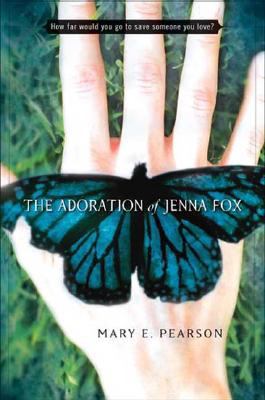
The Adoration of Jenna Fox by Mary E. Pearson

The Adoration of Jenna Fox
Mary E. Pearson
Henry Holt and Company
2008
As a librarian, I often have to read books because I'm not sure whether or not they'll be appropriate for the level of students I serve - whether because of reading level, content or interest.  Sometimes I come across a book that I can't put down but I know my kids won't be interested in.  Sometimes I read books that I find completely annoying, but as I read I can tick off the students who will go completely gaga over the story.
The Adoration of Jenna Fox is a bit of a mystery to me though,  Intriguing story, pretty good plot line, acceptable ending, but, in my professional opinion, very blah.  It's the story of a girl named Jenna who wakes from a coma after a terrible car accident that took place over a year ago.  She can hardly remember her life before the coma, but things come back to her in flashes.  Her parents are loving and fiercly protective, but her grandmother is distant - Jenna can sense that grandma just doesn't like her.  As the story unfolds, you find out just how much Jenna's parents adore her, and what lengths her dedicated mother and scientist father are willing to go to keep her safe and alive.  Her parents have provided her with stalker-esque (can your parents stalk you?) videos for each year of her life in the hopes that it will help her remember.  However, as she watches the videos, she realizes that things don't quite add up.  First of all, a scar on her chin is missing, then she realizes that she's a few inches shorter than she was before the accident.  As you can imagine, the teenager in Jenna starts to rebel and all hell breaks loose.
The premise of the book really is excellent - how much of a person must remain in order for it to be the same person.  Is a soldier who loses his/her arms and legs in battle still a whole person?  What if all that could be saved of a person is half their brain?  A third of their brain?  Would they still be the same person?  The problem I have with the book is that, well, I can't explain it.  It was just blah.  Parts of the plot that were supposed to be mysterious ended up being confusing and/or weird, and the ending - you all know how I feel about weak endings.  The end annoyed me.  Talk about rainbows and unicorns.  Sheesh.
So here's my dillema - and let's be honest, it's not really a dillema.  A dilemma would be solving the health care crisis or the Middle Eastern Conflict.  This is more of a "whiney moment".  I'm not sure my students will like the book.  According to the reviews students have loved this book for years - heck the second book in the series The Fox Inheritance just came out (don't get me started on that one.  It is NOT on my reading list.  Oi.), but no students names popped into my head as I was reading it, and I don't look forward to book talking it (though, there are lots of books that I can sell like candy to kids that I'm not a fan of.  'Tis one of my talents).  To purchase or not to purchase, that is the question.

I wouldn't recommend this book to students younger than 7th grade, but I think the majority of middle school students can handle it.  If you're looking for a quick read that is somewhat thought provoking, I'd recommend it, but don't expect literary grandeur.

01 September 2011

Unbroken by Laura Hillenbrand

Unbroken
Laura Hillenbrand
Random House
2010

Check out the label cloud over there on the right.  See how relatively small the nonfiction label is?  Yeah, it's pretty small.  That's because I like fiction.  Lots.  But every once in awhile an excellent nonfiction book works its way into my stack.  How thankful I am that Unbroken made its way into that pile.  And as rare as it is for me to read nonfiction, it's also rare for me to read a book that immediately makes me think "Wow, my dad would love this book!"  See, my dad is my inspiration for reading (see my post What Type of Reader are You? to understand why), and in the nearly 30 years we've both been readers, our reading tastes have starkly diverged.  On the rare occasion that I come across a book my dad would love, I get extremely excited and can't wait to recommend it to my Papa.*

Unbroken is the story of Louis "Louie" Zamperini.  It follows him through his entire life, starting with his troubled childhood in Torrence, California.  It then follows his quest for Olympic gold in the 5000m and his attempt at being the first man to run a 4-minute mile.  Then it follows him as he serves the Army Air Forces as a bombardier - crashing in the Pacific, surviving on a raft for over 40 days, and ending up as a POW in Japan. THEN it follows his post-war life as he tries to destroy himself and ultimately reinvents himself yet again in a way that I did not see coming.

Oh, and it's about 400 pages, not including 50+ pages of notes and the extensive index at the end.

Truthfully, the length didn't bother me at all.  It was so good, I cranked out about 200 pages in a day - one of those blissful days that involved little more than a comfy blanket, some ice cream, the occasional bathroom break and a good book.  Much like my favorite book The Power of One, this book reminded me of the power of the human spirit.  It reminded me that some of us - not all of us - have within us a resilience that allows us to take just about anything life throws at us and make it our proverbial b!tch.  Louie never claims to be super-strong or amazing, but those around him always knew that he was exceptional.  He, much like my favorite character every PeeKay, simply went through life putting one foot in front of the other, doing whatever was needed to survive.  And I suppose that is all that most of us do - some of us are just required to stretch much further in order to survive.

In the end, this book gave me yet another perspective on WWII.  And it gave me yet another reason to thank those who serve and fight for us.  What they go through for our freedom is unbelieveable.  Wow.

As a librarian, I would recommend this book to just about any adult interested in nonfiction, survival stories, or well-written books in general.  I would not recommend this book for younger readers - it's pretty intense.  High school would most likely be OK, but definitely not middle school.


*Fun story:  As soon as I finished the book, I met up with my dad and said "Dad, you absolutely have to read this book!" His response?  "I already read it.  Man, how much can one guy go through?" Foiled again!