Emory's Gift
W. Bruce Cameron
Forge
2011
If you happen to be one of the four people who know me and have not had to listen to me go on and on about the amazingness (it's a word) of A Dog's Purpose, then stop reading this post and read this one and then come back here.
If you aren't in the mood to blog surf, I'll just spit it out for you: W. Bruce Cameron has written a book that changed my life. I am a dog lover (not an animal lover necessarily, but definitely dogs) and A Dog's Purpose changed the way I view the mortality of the dogs I've loved in my life and why I keep the stinky little mutts around.
While at the library a few weeks ago, I decided to look for other books by Mr. Cameron, and that's how I came across Emory's Gift.
While the two books are very different, Cameron has a distinctive writing style that is enjoyable to read, and he definitely has a knack for plot twists.
Emory's Gift is about a thirteen year old, Charlie, and a grizzly bear, Emory. Charlie's life hasn't exactly been a walk in the park - his mother recently died of cancer and his father is struggling to keep it together. When you add the fact that he's in middle school, well, you can imagine how much life just sucks. One day while fishing in the stream behind his house, Charlie not only sees a grizzly bear, he pretty much feeds the bear the trout he'd caught. A few days later the bear writes the name Emory in the sand, and Charlie realizes that this bear is special, but he wants to keep Emory a secret. Eventually, it is clear that Emory doesn't want to be kept a secret, and Charlie and Emory embark on an unbelievable adventure.
By the end of the book I could not read fast enough and could not put it down. Cameron weaves a beautiful tale of adolescence, family and growing up in a small town. However the ending? Meh. Don't get me wrong, it wasn't bad - it was actually quite good. I was just expecting something more moving - the ending of A Dog's Purpose stuck with me long after I finished the book.
All in all, Emory's Gift is a great read - definitely something to pick up before going on vacation or a great read for a rainy weekend. Unline ADP, I don't think it's necessarily an all-ages book. It's more violent and I'm pretty sure it has a few four letter words. I'd recommend it for middle school and older, and to anyone who loves the outdoors and the idea that the unimaginable is possible.
Happy Reading!
S
A quasi-pointless blog of the books I recommend (and some I don't) and my life as a library ninja.
Showing posts with label adult. Show all posts
24 September 2012
06 June 2012
Best. Blog Post. Ever
If I had a nickle for every time I've been asked "Have you read Fifty Shades of Grey?", I'd have about $2. It doesn't seem like much, until you remember that we're talking nickles. It's gotten annoying.
There are many reasons I'm really not all that interested in reading this book, and I'll admit, I often shy away from super popular books. Why? Because I figure if they're THAT popular, they're probably good, so I don't need to read them (I'll admit, I only read book one of Harry Potter).
However, in the case of 50 Shades, I just don't think I'd like it.
Don't get me wrong, I love smut novels - they're fun to read - but this seems like it's a higher level of smut, and I'm really not currently in the mood for more-than-smut.
I could continue listing the reasons I'm not going to read the book, or I could just direct you to this amazing blog, where the blogger lines out some awesome reasons for not reading the book.
I mean, why reinvent the wheel? And, she's much funnier than I am.
28 May 2012
Impartial Witness by Charles Todd
An Impartial Witness
Charles Todd
Narrated by Rosalyn Landor
Audiobooks America 2010
As a librarian, my list of "must reads" is always longer than Crystal Gale's hair, so it's rare for me to just grab a book at the library. However, two weeks ago I had to make an emergency trip to Denver, and none of my requested audio books were in yet, so I decided to pick one off the shelf. Two things happened: one, I perused books on the shelf and chose a book based on cover art and the short summaries you find either on the back or on the inside of the dust jacket. I'll explore this topic in more depth later. Two, I found a great book by an author I'd never heard of that I really enjoyed.
The book I chose was An Impartial Witness by Charles Todd. It's a Bess Crawford mystery, and now that I've finished it, I know that there are actually multiple books in the series, and An Impartial Witness is the second of the series, and the newest of the series will be out next week. The Bess Crawford mysteries are historical mysteries, set in England during World War I. Bess is a very strong female - she's a field nurse for the military and she was an "army brat" of sorts, growing up in India where her father was a high-ranking officer (I can't ever keep military ranks straight, and since I listened to the audio book, there's no way I'm going to figure out his rank, sorry) in the British military. In all of the mysteries, Bess doesn't go looking for trouble, but she definitely doesn't know how to leave trouble alone once it finds her - a fact that is eluded to often in An Impartial Witness.
The book starts out with Bess treating a severely burned pilot who keeps a picture of his wife near him at all times. After transporting the man to a hospital in England, Bess takes a train to London for a few days leave before she must return to the front. As she's walking through the train station, she sees the woman from the photograph - the pilot's wife - but this woman is utterly despondent as she bids farewell to a different soldier. A few weeks later, Bess finds out that the woman was brutally murdered later on that same day. When Bess volunteers to help Scotland Yard with the investigation, she's caught up in the mystery and nearly gets herself killed a few times.
I loved that the book had a historical element to it that added to the "intrigue", however on the same note, I'm not too sure of the historical accuracy of the book. For example, the book takes place in 1917, and Bess has her own motorcar that she drives around like it's no big deal. That seems odd to me - but I wasn't alive in 1917, so maybe women were driving quite a bit back then. Also, I love that Todd has created a very strong female character who doesn't back down just because she's a female, but I was surprised at the fact that no one objected to her nosing around all the time. In the end, the flaws didn't outweigh the enjoyment I had listening to the book - Rosalyn Landor did a great job with voices and keeping the pace quick enough so that it wasn't boring.
I'd recommend this book to anyone who enjoys historical fiction, mysteries and strong female characters, but I wouldn't recommend it to readers who are particular about details. There's nothing terribly risque in the novel, so it could be HS appropriate, but the historical references and vocabulary would make it difficult for a reluctant reader or MS reader to follow.
Charles Todd
Narrated by Rosalyn Landor
Audiobooks America 2010
As a librarian, my list of "must reads" is always longer than Crystal Gale's hair, so it's rare for me to just grab a book at the library. However, two weeks ago I had to make an emergency trip to Denver, and none of my requested audio books were in yet, so I decided to pick one off the shelf. Two things happened: one, I perused books on the shelf and chose a book based on cover art and the short summaries you find either on the back or on the inside of the dust jacket. I'll explore this topic in more depth later. Two, I found a great book by an author I'd never heard of that I really enjoyed.
The book I chose was An Impartial Witness by Charles Todd. It's a Bess Crawford mystery, and now that I've finished it, I know that there are actually multiple books in the series, and An Impartial Witness is the second of the series, and the newest of the series will be out next week. The Bess Crawford mysteries are historical mysteries, set in England during World War I. Bess is a very strong female - she's a field nurse for the military and she was an "army brat" of sorts, growing up in India where her father was a high-ranking officer (I can't ever keep military ranks straight, and since I listened to the audio book, there's no way I'm going to figure out his rank, sorry) in the British military. In all of the mysteries, Bess doesn't go looking for trouble, but she definitely doesn't know how to leave trouble alone once it finds her - a fact that is eluded to often in An Impartial Witness.
The book starts out with Bess treating a severely burned pilot who keeps a picture of his wife near him at all times. After transporting the man to a hospital in England, Bess takes a train to London for a few days leave before she must return to the front. As she's walking through the train station, she sees the woman from the photograph - the pilot's wife - but this woman is utterly despondent as she bids farewell to a different soldier. A few weeks later, Bess finds out that the woman was brutally murdered later on that same day. When Bess volunteers to help Scotland Yard with the investigation, she's caught up in the mystery and nearly gets herself killed a few times.
I loved that the book had a historical element to it that added to the "intrigue", however on the same note, I'm not too sure of the historical accuracy of the book. For example, the book takes place in 1917, and Bess has her own motorcar that she drives around like it's no big deal. That seems odd to me - but I wasn't alive in 1917, so maybe women were driving quite a bit back then. Also, I love that Todd has created a very strong female character who doesn't back down just because she's a female, but I was surprised at the fact that no one objected to her nosing around all the time. In the end, the flaws didn't outweigh the enjoyment I had listening to the book - Rosalyn Landor did a great job with voices and keeping the pace quick enough so that it wasn't boring.
I'd recommend this book to anyone who enjoys historical fiction, mysteries and strong female characters, but I wouldn't recommend it to readers who are particular about details. There's nothing terribly risque in the novel, so it could be HS appropriate, but the historical references and vocabulary would make it difficult for a reluctant reader or MS reader to follow.
15 May 2012
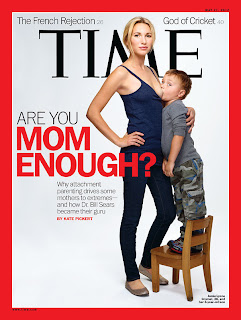
Article Review - TIME Magazine and Parental Guilt
![]() |
| Courtesy of Time.com |
I've never blogged about a newspaper/magazine article before, but the cover of last week’s TIME magazine sparked such a discussion, that I was not only intrigued, I couldn’t wait to read the article. The only problem is, now that I've read the article, I REALLY don't know what to think. I was offended by the cover for oh-so-many reasons, and now that I've read the article, I'm even MORE offended by the cover and a little confused.
For the record, I do not have children. So if the fact that I am going to comment on what I know about breastfeeding and raising children without any first-hand experience (other than helping to raise my nieces, nephews, etc.) will offend you, thanks for stopping by, but you should probably stop reading now.
Let’s start with the cover, since it’s the what got me going. My brain tells me that the cover is meant to be shocking. TIME has done this in the past (here’s the cover that creeped me out so much I tore it off the magazine), and because the article is technically about extreme parenting, the cover should be extreme right? The only problem is that in this case, the cover feeds into some misconceptions about breastfeeding. Last week Facebook, Twitter and my RSS feed were absolutely buzzing over the cover – even before people read the article. Comments ranged from breastfeeding a 3-year-old borders on child abuse and she’s too sexy to be a breast-feeding mom to that kid is totally going to show off this picture when he’s high school and his buddies are going to be jealous. I’d say 90 percent of the comments were, in my humble opinion, asinine and uninformed. Regardless of the shocking nature of the cover, I have to say I think TIME took it too far, only because I think this cover will now be fuel for the idea that breastfeeding is “weird”, even though all obstetricians out there would say that breastfeeding is beneficial. And I doubt that most moms breastfeed their children using a stepstool. Just sayin.
However, what REALLY bothered me about the cover was the caption: “Are you Mom enough?” It suggests that mothers who aren’t willing to go to extremes – like breastfeeding to the age of 3 or older – for their children are terrible mothers. And that, even though I’m not a mom, offends me right straight down to my core. I know some women who were able to breastfeed their children for over a year, and I commend them for that. I also know women who wanted to breastfeed for longer than they were able and were absolutely tormented by their inability. We’re talking 2am bawling phone calls about being inadequate mothers simply because they couldn’t produce enough milk. I also know mothers who physically can’t breastfeed – take, for example, my dear friend Adi, who just adopted a sweet little girl. Is Adi to believe she’s not “mom enough” because after years of trying to get pregnant, she now has a beautiful daughter she can’t breastfeed?
Sorry TIME, but I think the cover takes it a little too far to the extreme. I truly believe the article would have been well read and copies would have sold even if the cover hadn’t been so provocative.
Now for the actual article itself. For one, it's really not about breastfeeding at all. It's about Dr. Bill Sears and attachment parenting. Yes, breastfeeding is an important tenant of the attachment parenting movement, but it’s not the only tenant, AND it’s barely mentioned in the article! The article actually focuses more on sacrificing for one’s children and the author seems to take more issue with the idea of co-sleeping. In fact, it’s pretty clear that the author thinks Dr. Bill is crazy and attachment parenting is extreme, even though Dr. Bill even says himself that parents should do the best they can with what they have.
From what I know about attachment parenting, I think the ideas are great, but just like anything associated with parenting, it can lead to massive amounts of parental guilt. I think that’s what bothers me the most about this article and the cover. I have seen moms racked with guilt over things like letting their kids watch TV or have chocolate after dinner. TIME attempts to address this with a little inset about “detachment fathering”, but unfortunately, this little snippet angered me just as much as everything else. The author, Nathan Thornburg, is basically telling dad’s that it’s OK not to feel guilty if you don’t do as much as your child’s mother because attachment parenting really is all about ‘attachment mothering’. I agree with the idea that parents need to work to “distance themselves from the expectations set by everyone from Sears to your peers in mommy-and-me-yoga”, but I don’t agree with the idea that it’s ok to slack off as a parent because “children can – and often do – get by without a father in their lives at all”. That’s a steaming load of crap if I do say so myself.
In the end, I think TIME intended to bring light to a new trend in our society, but all they’ve successfully done is add to the unbelievable guilt that parents face each and every day. Usually, I can stomach what TIME puts out there – mostly because I’m aware of the slant they put on things. However, this slant is too much for me. I think of all the amazing moms that I know out there and my heart breaks for them - reading a magazine shouldn't add to guilt feelings! So TIME, in my humble opinion, you really missed the mark on this one.
19 October 2011
My Fair Lazy by Jen Lancaster
My Fair Lazy : One Reality Television Addict's Attempt to Discover if Not Being a Dumb Ass is the New Black, or a Culture-Up Manifesto
Jen LancasterNew American Library
2010
For the rest of you who lovingly laugh at my stupid jokes and my inability to keep my mouth shut and not say the sarcastic thing I’m thinking about the moron across the room, please go read any of Jen Lancaster’s books. Why? For one, she writes like I talk (only much funnier). But there are many reasons.
First, she is the master of the footnote. After finishing my masters, I said something along the lines of “I never want to read another footnote or annotation again!” But Lancaster taught me that footnotes can be fun!
Her sense of humor is sarcastic, pointed and, well, right. She, like me, says the things the rest of you don’t want to say out loud but think. She just gets paid for it. I work for peanuts to “change the future”. Don’t get me wrong, I love what I do, but sarcasm and middle school students make a fire-y cocktail that usually ends in tears. But more importantly, she’s real, and her humor is real. Her books are not fantasy, they are not science fiction, and when you read her books, there is no suspense of reality. She writes about things that happen to all of us: getting laid off, getting fat and learning that we know nothing.
My Fair Lazy is, as the title explains, a memoir about the quest to move from reality TV to real life. In the book she realizes that while she is a wealth of TV and movie facts, but when it comes to literature, the theater or anything non-Jersey Shore related, she’s lost. So she sets out to better herself and its hilarious every step of the way. While Lancaster is able to find humor in just about every situation, she is also extremely real, and that’s what makes me love her even more. When I read about her dog getting sick, I teared up and then laughed because she then described the dog’s stench in great detail.
What makes me love her even more is the fact that she realizes how little she knows about the world and chooses to do something about it, without losing who she is. So many people think that reality TV is real, and…I hate to burst bubbles, but…it’s not. Reality TV stopped being real before the turn of the century. It’s still fun to watch, and might be mildly educational (the Amazing Race teaches us about geography and various cultures, and anything on MTV teaches us about drugs and contracting STDs), but to experience life you have to live it, not watch it. In the end, Lancaster doesn’t become a know-it-all, nor does abandon her television habits. She just becomes a more well-rounded person. Which, in this case, is a good thing. If you want to read about her quest to fight the “roundness” in her life, pick up Such a Pretty Fat. It’s amazing.
Who would I recommend this book to? It's difficult to recommend one of Jen's books. But her books in general? I'd recommend to anyone who has ever wanted to make a sarcastic remark and hasn't, anyone who has ever realized that they aren't actually perfect but are willing to come to terms with it, or anyone who wants a good belly laugh when they read, I'd highly recommend this book. And truthfully, if you can get through one of her books without laughing, I will give you $100.
If you need short little doses of hilarity, check out her blog:
http://www.jennsylvania.com/
It too is quite awesome (though she's working on her newest book, so lately it's been a bit slow).
Who would I recommend this book to? It's difficult to recommend one of Jen's books. But her books in general? I'd recommend to anyone who has ever wanted to make a sarcastic remark and hasn't, anyone who has ever realized that they aren't actually perfect but are willing to come to terms with it, or anyone who wants a good belly laugh when they read, I'd highly recommend this book. And truthfully, if you can get through one of her books without laughing, I will give you $100.
If you need short little doses of hilarity, check out her blog:
http://www.jennsylvania.com/
It too is quite awesome (though she's working on her newest book, so lately it's been a bit slow).
06 September 2011
I am Nujood, Age 10 and Divorced by Nujood Ali
I am Nujood, Age 10 and Divorced Nujood Ali with Delphine Minoui
Translated by Linda Coverdale
Three Rivers Press
2010
I like to think of myself as a strong, independent woman. However, reading a story like Nujood's, I find myself wondering what I would do if I were in an arranged, abusive marriage. I'd like to think I'd have the courage to step up and walk away, but I also know that a great portion of my strength comes from my family, so I think if I were in an abusive marriage that was arranged by my family, I'm not sure I'd be able to walk away without their support. But I think I'd be able to do it. My family isn't the only community I have, so I think it would be painful and it'd take a truckload of prayer and support, but I'd be able to do it.
Having said that, I'm 33, employed and live in a country where my voice is heard regardless of my gender. When I read the story of Nujood - the ten year old girl in Yemen who walked into a courthouse one day and demanded a divorce - I realized that while I might think I'm strong, I can't imagine the strength and courage this young woman has (when you hear her story, you'll understand why I find it hard to think of her as a little girl). Nujood was only ten years old when her father married her off to a man three times her age and sent her to live with her new in-laws far away from the only family she has ever known. Her new family will not allow her to go to school, and though her new husband promised not to touch her until she was old enough (the accepted age in Yemen is thirteen. THIRTEEN), he forces himself on her regularly. Though she doesn't have much understanding of how the world works, she knows that a judge can help her, so one day she pulls together all her courage and enough money to ride the bus to the courthouse and finds a judge and asks the judge for a divorce. Wow.
The book is a quick read that is expertly written - Delphine Minoui does an amazing job of balancing Nujood's strength and character with the simple fact that she is just a little girl. In one scene she walks into the courthouse demanding a divorce in a country where women are often ignored altogether, and in the next, she is thankful that she has made new friends (the children of one of the judges who agrees to help her) and that she can play with dolls instead of being scared to sleep. You want to feel sorry for Nujood, but you just can't - she doesn't want people to feel sorry for her. She wants people to learn from her story and help others.
I would recommend this book to anyone who is interested in what life is like for women in the Middle East. I've read books about life for women in Iraq, Iran, Pakistan and now Yemen. Some of the accounts are terribly frightening and depressing, and some show hope - much like Nujood's. And I know that stories like this are not limited to "other places" - terrible things happen around the world, in every country, every day. Luckily, we have stories like Nujood's that inspire us and remind us that it's important to look out for each other and to do what we know is right - even if the societal norm has been/is contrary.
If you want to read more about Nujood without reading the book, here is Glamour Magazine's article naming Nujood and her lawyer as 2008 Women of the Year.
If hearing stories like Nujood's gets your helping genes racing, I'd recommend Vital Voices as a wonderful organization to support.
Translated by Linda Coverdale
Three Rivers Press
2010
I like to think of myself as a strong, independent woman. However, reading a story like Nujood's, I find myself wondering what I would do if I were in an arranged, abusive marriage. I'd like to think I'd have the courage to step up and walk away, but I also know that a great portion of my strength comes from my family, so I think if I were in an abusive marriage that was arranged by my family, I'm not sure I'd be able to walk away without their support. But I think I'd be able to do it. My family isn't the only community I have, so I think it would be painful and it'd take a truckload of prayer and support, but I'd be able to do it.
Having said that, I'm 33, employed and live in a country where my voice is heard regardless of my gender. When I read the story of Nujood - the ten year old girl in Yemen who walked into a courthouse one day and demanded a divorce - I realized that while I might think I'm strong, I can't imagine the strength and courage this young woman has (when you hear her story, you'll understand why I find it hard to think of her as a little girl). Nujood was only ten years old when her father married her off to a man three times her age and sent her to live with her new in-laws far away from the only family she has ever known. Her new family will not allow her to go to school, and though her new husband promised not to touch her until she was old enough (the accepted age in Yemen is thirteen. THIRTEEN), he forces himself on her regularly. Though she doesn't have much understanding of how the world works, she knows that a judge can help her, so one day she pulls together all her courage and enough money to ride the bus to the courthouse and finds a judge and asks the judge for a divorce. Wow.
The book is a quick read that is expertly written - Delphine Minoui does an amazing job of balancing Nujood's strength and character with the simple fact that she is just a little girl. In one scene she walks into the courthouse demanding a divorce in a country where women are often ignored altogether, and in the next, she is thankful that she has made new friends (the children of one of the judges who agrees to help her) and that she can play with dolls instead of being scared to sleep. You want to feel sorry for Nujood, but you just can't - she doesn't want people to feel sorry for her. She wants people to learn from her story and help others.
I would recommend this book to anyone who is interested in what life is like for women in the Middle East. I've read books about life for women in Iraq, Iran, Pakistan and now Yemen. Some of the accounts are terribly frightening and depressing, and some show hope - much like Nujood's. And I know that stories like this are not limited to "other places" - terrible things happen around the world, in every country, every day. Luckily, we have stories like Nujood's that inspire us and remind us that it's important to look out for each other and to do what we know is right - even if the societal norm has been/is contrary.
If you want to read more about Nujood without reading the book, here is Glamour Magazine's article naming Nujood and her lawyer as 2008 Women of the Year.
If hearing stories like Nujood's gets your helping genes racing, I'd recommend Vital Voices as a wonderful organization to support.
01 September 2011
Unbroken by Laura Hillenbrand
Unbroken
Laura Hillenbrand
Random House
2010
Check out the label cloud over there on the right. See how relatively small the nonfiction label is? Yeah, it's pretty small. That's because I like fiction. Lots. But every once in awhile an excellent nonfiction book works its way into my stack. How thankful I am that Unbroken made its way into that pile. And as rare as it is for me to read nonfiction, it's also rare for me to read a book that immediately makes me think "Wow, my dad would love this book!" See, my dad is my inspiration for reading (see my post What Type of Reader are You? to understand why), and in the nearly 30 years we've both been readers, our reading tastes have starkly diverged. On the rare occasion that I come across a book my dad would love, I get extremely excited and can't wait to recommend it to my Papa.*
Unbroken is the story of Louis "Louie" Zamperini. It follows him through his entire life, starting with his troubled childhood in Torrence, California. It then follows his quest for Olympic gold in the 5000m and his attempt at being the first man to run a 4-minute mile. Then it follows him as he serves the Army Air Forces as a bombardier - crashing in the Pacific, surviving on a raft for over 40 days, and ending up as a POW in Japan. THEN it follows his post-war life as he tries to destroy himself and ultimately reinvents himself yet again in a way that I did not see coming.
Oh, and it's about 400 pages, not including 50+ pages of notes and the extensive index at the end.
Truthfully, the length didn't bother me at all. It was so good, I cranked out about 200 pages in a day - one of those blissful days that involved little more than a comfy blanket, some ice cream, the occasional bathroom break and a good book. Much like my favorite book The Power of One, this book reminded me of the power of the human spirit. It reminded me that some of us - not all of us - have within us a resilience that allows us to take just about anything life throws at us and make it our proverbial b!tch. Louie never claims to be super-strong or amazing, but those around him always knew that he was exceptional. He, much like my favorite character every PeeKay, simply went through life putting one foot in front of the other, doing whatever was needed to survive. And I suppose that is all that most of us do - some of us are just required to stretch much further in order to survive.
In the end, this book gave me yet another perspective on WWII. And it gave me yet another reason to thank those who serve and fight for us. What they go through for our freedom is unbelieveable. Wow.
As a librarian, I would recommend this book to just about any adult interested in nonfiction, survival stories, or well-written books in general. I would not recommend this book for younger readers - it's pretty intense. High school would most likely be OK, but definitely not middle school.
*Fun story: As soon as I finished the book, I met up with my dad and said "Dad, you absolutely have to read this book!" His response? "I already read it. Man, how much can one guy go through?" Foiled again!
Laura Hillenbrand
Random House
2010
Check out the label cloud over there on the right. See how relatively small the nonfiction label is? Yeah, it's pretty small. That's because I like fiction. Lots. But every once in awhile an excellent nonfiction book works its way into my stack. How thankful I am that Unbroken made its way into that pile. And as rare as it is for me to read nonfiction, it's also rare for me to read a book that immediately makes me think "Wow, my dad would love this book!" See, my dad is my inspiration for reading (see my post What Type of Reader are You? to understand why), and in the nearly 30 years we've both been readers, our reading tastes have starkly diverged. On the rare occasion that I come across a book my dad would love, I get extremely excited and can't wait to recommend it to my Papa.*Unbroken is the story of Louis "Louie" Zamperini. It follows him through his entire life, starting with his troubled childhood in Torrence, California. It then follows his quest for Olympic gold in the 5000m and his attempt at being the first man to run a 4-minute mile. Then it follows him as he serves the Army Air Forces as a bombardier - crashing in the Pacific, surviving on a raft for over 40 days, and ending up as a POW in Japan. THEN it follows his post-war life as he tries to destroy himself and ultimately reinvents himself yet again in a way that I did not see coming.
Oh, and it's about 400 pages, not including 50+ pages of notes and the extensive index at the end.
Truthfully, the length didn't bother me at all. It was so good, I cranked out about 200 pages in a day - one of those blissful days that involved little more than a comfy blanket, some ice cream, the occasional bathroom break and a good book. Much like my favorite book The Power of One, this book reminded me of the power of the human spirit. It reminded me that some of us - not all of us - have within us a resilience that allows us to take just about anything life throws at us and make it our proverbial b!tch. Louie never claims to be super-strong or amazing, but those around him always knew that he was exceptional. He, much like my favorite character every PeeKay, simply went through life putting one foot in front of the other, doing whatever was needed to survive. And I suppose that is all that most of us do - some of us are just required to stretch much further in order to survive.
In the end, this book gave me yet another perspective on WWII. And it gave me yet another reason to thank those who serve and fight for us. What they go through for our freedom is unbelieveable. Wow.
As a librarian, I would recommend this book to just about any adult interested in nonfiction, survival stories, or well-written books in general. I would not recommend this book for younger readers - it's pretty intense. High school would most likely be OK, but definitely not middle school.
*Fun story: As soon as I finished the book, I met up with my dad and said "Dad, you absolutely have to read this book!" His response? "I already read it. Man, how much can one guy go through?" Foiled again!
22 July 2011
The Five Dysfunctions of a Team by Patrick Lencioni
The Five Dysfunctions of a Team: A Leadership Fable
Patrick Lencioni
With only one week left until I (fingers crossed!) complete my Master's Degree, I figured it was about time for me to review one of the many books I've had to read for that degree. And this was the best book I had to read for my graduate program. It wasn't written in the same style as the other educational theory books I've read - many of those books come across as inspriational-self-helpy. This one didn't. In fact, on many occasions Lencioni says that working toward fixing any of the five dysfunctions is often the most difficult task any professional will face in their career. He also makes it clear that we all will face all five of the dysfunctions at some point.
The book starts out as a fable. Kathryn has just been hired as CEO at DecisionTech - a company that despite it's amazing start, is faultering. She is faced with the task of "fixing" the very dysfunctional executive team - a task that is not easy. There is no holding hands, singing kumbaya. Lencioni does an amazing job of weaving his theory of 5 dysfunctions into a very real story that is not self-helpy at all. In fact, the theory is so simple and the fable is so well written, it causes the reader to understand that working together on a team can be an excellent thing - meetings don't have to be boring, politics can be left outside, and real results can be achieved. And although some parts of the story would not work in a school setting, his theory could absolutely bring about change to any dedicated team that is looking to work more effectively together.
The other thing I liked about the book is the fact that even though it sounds like it's going to be super negative, it is actually written from a very positive viewpoint. Lencioni basically says, here are the five biggest, intertwined issues facing businesses/groups today, and here's why and how you can fix them.
I will not say that I have completely bought into his theory. However, I will say that unlike many of the other books I've read, this one actually seems like it can work, and Lencioni doesn't claim that his method is the ultimate fixer of all woes. It's just on way to make working with other adults more effective. And as a teacher, I know that working with other adults is often more difficult than working with teenagers (ask any teacher you know and they'll agree with me. The only reason other people don't agree is because they haven't had to work with teenagers...)
Patrick Lencioni
With only one week left until I (fingers crossed!) complete my Master's Degree, I figured it was about time for me to review one of the many books I've had to read for that degree. And this was the best book I had to read for my graduate program. It wasn't written in the same style as the other educational theory books I've read - many of those books come across as inspriational-self-helpy. This one didn't. In fact, on many occasions Lencioni says that working toward fixing any of the five dysfunctions is often the most difficult task any professional will face in their career. He also makes it clear that we all will face all five of the dysfunctions at some point.
The book starts out as a fable. Kathryn has just been hired as CEO at DecisionTech - a company that despite it's amazing start, is faultering. She is faced with the task of "fixing" the very dysfunctional executive team - a task that is not easy. There is no holding hands, singing kumbaya. Lencioni does an amazing job of weaving his theory of 5 dysfunctions into a very real story that is not self-helpy at all. In fact, the theory is so simple and the fable is so well written, it causes the reader to understand that working together on a team can be an excellent thing - meetings don't have to be boring, politics can be left outside, and real results can be achieved. And although some parts of the story would not work in a school setting, his theory could absolutely bring about change to any dedicated team that is looking to work more effectively together.
The other thing I liked about the book is the fact that even though it sounds like it's going to be super negative, it is actually written from a very positive viewpoint. Lencioni basically says, here are the five biggest, intertwined issues facing businesses/groups today, and here's why and how you can fix them.
I will not say that I have completely bought into his theory. However, I will say that unlike many of the other books I've read, this one actually seems like it can work, and Lencioni doesn't claim that his method is the ultimate fixer of all woes. It's just on way to make working with other adults more effective. And as a teacher, I know that working with other adults is often more difficult than working with teenagers (ask any teacher you know and they'll agree with me. The only reason other people don't agree is because they haven't had to work with teenagers...)
14 June 2011
The Reader (Der Vorleser) by Bernhard Schlink
The Reader
Yes, I am fully aware that I’m about ten years late on reading this book. But I assure you I have a good reason. Ok, so I don’t really have a good reason, but I have a reason. See, I have tried to read this book two other times, but couldn’t get through it. Not because of the writing – it is exquisite. I couldn’t get through it because of my language barrier. Somewhere along the line (probably around 2001) I decided that I needed to read books written by German authors in German (I also decided I needed to read cheesy romance novels and YA lit like Harry Potter in German so that I wouldn’t be so “embarrassed” by reading them. Well, I got over that about six years ago). So I’ve tried to read the original version of The Reader (Der Vorleser) on two other occasions. I could get through the first few chapters, but then I was confronted with words and concepts that I didn’t understand – especially when Michael is in law school and discusses abstract concepts. Anyway, I finally decided that I really wanted to read the book and I “wussed out” and read it in English.
I’m so glad I did. What a beautiful novel about life, hardships and how our perceptions of people can be completely wrong for the silliest/craziest reasons! This book reminds me quite a bit of the movie Crash because it takes difficult situations and looks at them deeply and honestly. Anna’s reasons for working at Kraków had nothing to do with her political leanings or beliefs, but people were (and can still be) so blinded by the atrocities of WWII they couldn’t see the truth. Not that I think what happened to the millions of people persecuted during the Holocaust is in anyway acceptable. What bothers me the most in many cases is that when we look back on history, we blanket what happened and blame haphazardly – much like Michael found himself doing in the book. He wanted to blame his parents for not doing more, and he wanted to find Anna guilty. And in many ways, he can and did. But he realized, as I hope we can continue to realize as we examine history honestly, that their guilt is not as simple as it seems. Fear, hunger and oppression were not hardships faced only by the prisoners of those camps. Fear, hunger and oppression don’t make any of the events of WWII acceptable, but trying to understand what daily life was like for Germans during that time helps us understand how they could allow such things to happen. And if nothing, understanding the why of the every day person during that time will help us identify the possibility of it happening again in the future. Hopefully, we can see that when a people are hungry, jobless and scared, leadership can come in and take advantage of that weakness, and disaster can ensue if we aren’t careful.
Ok, so back to the book. Michael is a young man who, early in life, has an affair with a much older woman. As their relationship progresses Anna has Michael read to her – something that Michael perceives as romantic and loving. Later in life, Anna is put on trial for crimes she committed as a guard at the Kraków work camp near Auschwitz. Michael, a young law student, attends her trial and tries to reconcile this new Anna with the old Anna. He realizes, during her trial, that she is covering up a secret that is much deeper and darker than he could have imagined, but her shame in both her actions as an officer and her secret confuse him and he is at a loss for what to do for her.
The ironic part of my experience reading this book is the fact that I shied away from it because of my “reading barrier”. I could have experience this book in all it’s splendor years ago but I didn’t because of my stupid bilingual pride. And now that I’ve finished the book, I’m left with the question – am I really that different from Anna? Granted, I didn’t work at Kraków, and I’d like to think I have enough humanity to save people from atrocities. But reading and good literature are such a huge part of my life, yet I’ve kept myself from so much great literature with my stupid rule. Now I’m moved to try to find other areas of my life where I’ve unknowingly created barriers for myself. And I totally plan to read the original version now so I can look at his writing style!
Any thoughts?
11 May 2011
Hush by Eishes Chayil
Hush
Eishes Chayil
Here are some other great reviews of this book:
Velveteen Rabbi
Readergirlz
Eishes Chayil
The cover of this book reads “What happens when you are betrayed by those you trust the most?” Who can pass up a book with a caption like that? Honestly, usually I can. Truthfully, the cover of this one didn’t really do it for me, but luckily I’d heard enough buzz about it that I went ahead and requested it through interlibrary loan (greatest system EVER).
Gittel is a young woman who has grown up within the comfort and safety of her Chassidic Jewish community of Borough Park. She has learned to be pious, and longs for the day she will marry and her soul will find its’ match. The one dark spot in Gittel’s life is the memory of her best friend, Devory, who died when they were 9. Gittel knows there is more to what happened to Devory than she was told, but whenever she tries to uncover the truth, she is met with silence, fear and a healthy dose of denial. The book alternates between present day and Gittel’s memories of Devory and all that happened to her, and her story is heart-wrenching and joyful all at the same time. The author still lives within the Chassidic community but felt it so important that this story be told, she has chosen the pseudonym Eishes Chayil, meaning Woman of Valor.
What struck me about this book is that it could be a gritty, terrifying book. What happened to Devory is horrifying and should not go unnoticed. But Chayil has written an account of violence in such a way that the horror of the actions of a few do not take away from the love, morality and piety of the many. She balances the heart and soul of the Chassidic community with the unspeakable acts that sometimes occur within their sheltered neighborhoods. I think it’s important that she maintain this balance because unspeakable acts like domestic abuse, child abuse, etc. happen in every community, and every community values morality, piety and family. This account does not allow the reader to dismiss the Chassidic community as evil or bad, but forces us to recognize the atrocities that happen everywhere. By presenting the story in this manner, she has allowed us to see the thorns of the rose. And the strength of her family and loved ones in the end moved me to tears. Gittel and her family represent the good of the Chassidic community, and really, any faith community – following God (or whatever deity you worship), loving those around you and doing what is right and good, even if it’s difficult sometimes.
Here are some other great reviews of this book:
Velveteen Rabbi
Readergirlz
10 May 2011
The Radleys by Matt Haig
The Radley’s
So I’ll be the first to say, vampire are sooo last week. Twilight, the Chronicles of Vladimir Tod, and the House of Night are the books that started it all, and now we have TV series like Vampire Diaries and True Blood (does anyone remember the original vampire series – Buffy the Vampire Slayer? Can I get a heck yeah?). When I first read about The Radleys on the Alex Award List, I thought “ugh…not again”. But then I read the jacket and I was intrigued. Behold, the power of a well written book jacket!
The Radleys is the story of a small town family of vampires, only they aren’t your normal vampires (but when, since Count Dracula, have we had a story of “normal” vampires) because of two things. The parents are abstaining vampires – they do not drink blood, and the children don’t know they are vampires. And in classic style, because the children don’t really know what they are, the book opens and both are struggling to figure out who they are. Rowan has a crush on a local girl, Eve, but lacks the confidence to even speak to her, and Clara is so desperate to get animals to like her that she is attempting to go vegan – a choice that, unbeknownst to her, could ultimately kill her. When Clara accidentally tastes human blood, her hereditary instincts take over and she accidentally kills someone. Now that the secret is out, all of the members of the Radley clan feel their lives turn upside down. Enter Uncle Will – the practicing vampire that can save them all. But there are more secrets hiding on Orchard Lane than one would expect.
I will not say that this is the greatest book I’ve ever read, but it definitely kept me turning the pages. And I can completely see why this book was chosen for an Alex Award – an award given to books written for adults that experience wide success as YA books. Haig created enough suspense that the reader wonders what will come next, and there are just enough plot twists to keep you on the edge of your seat. I had at least two *Gasp* moments, and I once said “OH NO” aloud – which wasn’t a good idea because I was reading…oops. Though this book may not make my favorite book list, I will say that Haig has definitely taken a somewhat overused genre – vampires – and taken it to a new place and written a great novel.
Here are some other reviews of this book:
10 November 2010
The Help
The Help
I’m a pretty busy lady, but I definitely like to find those lazy days when I can just sit and read and forget about the world around me. Sometimes, I come across a book that is so engrossing that I can’t help but become completely absorbed – so absorbed that I forget about my reality and feel like I live in the reality of the book.
The Help by Katherine Stockett was one of those books for me. My book club chose to read this book, and I was surprised by the choice because the book is very new. Normally we stick with book club kits from the public library (in case you didn’t know, public libraries = free books, and that fits well into my tight budget), but some of the girls in our group had heard such great things, we all decided to fork over the cash and read it.
What a wonderful story! The Help is a book about exactly that – the hired help. Written from three points of view, The Help takes a look at what it was like to be the hired help in Mississippi during the 60’s. Skeeter is a twenty-something college graduate whose dream is to work as a journalist, but whose parents want nothing more for her than marriage to an acceptable young southern man. As she spends more and more time at home, she realizes that she does not share the same views as her now-grown childhood friends – especially when it comes to the African-American women who serve in their homes. And she realizes that these women – the hired help – do not have a voice at all. So she hatches a plan to share their voice with the world. Enter Aibileen and Minny. Both women have served as the hired help for their entire adult lives – Aibileen has faithfully and lovingly served many families, and Minny’s mouth has gotten her fired from many jobs, but her amazing cooking skills have always helped her find another job. Though Skeeter’s plan will put all the women at risk, all the women know that the stories they have to tell are absolutely worth it.
The Help is one of those books that really makes you think about the world around you. Sometimes we get so wrapped up in our own take on things, we fail to see that there are other points of view, other stories to be told, that are just as important as ours, and that can and do have a profound effect on us. Some of the characters in the book didn’t have the ability to see the world through the eyes of the people who worked for them. In a way, I felt sorry for them – it has to be difficult to live in a world where people don’t see things your way. And though the book deals with race relations in the 60’s, I think this lesson still rings true – and it doesn’t have to apply just to race relations. The Help encourages us to try walking a mile in someone else’s shoes.
22 June 2010
A Dog's Purpose - W. Bruce Cameron
First of all, I'd like to thank Di Herald and the kids who keep the Bistro Book Club in Grand Junction going throughout the summer.
For those of you who are not librarians or deeply involved in the world of books and publication, there are these AWESOME things called Advanced Reading Copies ( ARCs) or Advanced Reading Editions (AREs). Often times publishers will send out ARCs to booksellers, reviewers, etc. That's how those great reviews like "Thrilling!" end up on the jackets. Anyway, because our local book club is under the umbrella that allows students to vote on the Teen's Top Ten finalists, we get lots and lots of ARCs. And it's because of all these ARCs that the treasure that is A Dog's Purpose ended up in my hands.
A Dog's Purpose is the story that follows one dog throughout his lives. Yes, that's right, lives. After his first life is cut short, he comes back again as another puppy. And throughout the story, he tries very hard to figure out what his purpose is. As he lives his various lives, he strives to be a 'good dog', and he also realizes that his purpose is much more complex than he thought. The book is laugh-out-loud funny and a complete tear-jerker. I will never look at a dog the same, and even today, when I was walking my cute doggies at the park, I couldn't help but wonder, "is that W. Bruce Cameron on to something?"
To say that I highly recommend this book is an understatement. I adored this book and recommend it to anyone who has ever loved a dog.
It will be available for purchase on July 6th. You can buy advanced copies, and on the website A Dog's Purpose, there is an opportunity to donate 10% of the cover price to animal charities all over the country.
And just because I can and they're cute: here are my doggies ready for a hike:
21 June 2010
The Piano Tuner - Daniel Mason
The Piano Tuner
Daniel Mason
Once again, my book club has chosen a book that many of us will not finish and fewer of us will enjoy. I know that I'm in the camp that finished the book, but the jury is still out as to whether I'll be on team "I enjoyed it" or not. Admittedly, the book has an amazing premise: A middle aged English piano tuner is summoned to Burma during the 1880's to tune a piano for an eccentric army commander.
I will say that his adventure is quite adventurous. I did enjoy the descriptions of his travel. It was interesting to watch as Edgar Drake tried his hardest to step out of his shy little world and experience the wonders of the Orient. And when I consider the book from a literary stand point, I really appreciated his character. Maybe the thing holding me back from jumping into camp "AwesomeBook" is the fact that I've read so much teen lit lately that my brain has rewired itself to only enjoy page turners that either include vampires, death matches or fairies.
And if I'm honest, in the end, Edgar really did step out of his little world and go all out for what he loved and believed in. As for the ending? I will say that it left me wanting more. However, I think Edgar's entire existence left me wanting more, and that might be part of the conflict in this novel. Edgar's passion sends him off on amazing adventures. Is it better to follow your passion, or be safe and secure in life?
Daniel Mason
Once again, my book club has chosen a book that many of us will not finish and fewer of us will enjoy. I know that I'm in the camp that finished the book, but the jury is still out as to whether I'll be on team "I enjoyed it" or not. Admittedly, the book has an amazing premise: A middle aged English piano tuner is summoned to Burma during the 1880's to tune a piano for an eccentric army commander.
I will say that his adventure is quite adventurous. I did enjoy the descriptions of his travel. It was interesting to watch as Edgar Drake tried his hardest to step out of his shy little world and experience the wonders of the Orient. And when I consider the book from a literary stand point, I really appreciated his character. Maybe the thing holding me back from jumping into camp "AwesomeBook" is the fact that I've read so much teen lit lately that my brain has rewired itself to only enjoy page turners that either include vampires, death matches or fairies.
And if I'm honest, in the end, Edgar really did step out of his little world and go all out for what he loved and believed in. As for the ending? I will say that it left me wanting more. However, I think Edgar's entire existence left me wanting more, and that might be part of the conflict in this novel. Edgar's passion sends him off on amazing adventures. Is it better to follow your passion, or be safe and secure in life?
09 June 2010
The Namesake - Jhumpa Lahiri
The Namesake
Jhumpa Lahiri
This book was a very interesting read for many reasons. First - it's written by a Pulitzer Prize winning author. After my experiences with The Brief and Wondrous Life of Oscar Wao, I am a little leery of Pulitzer Prize winners (call me a literary whimp...I like things to move fast and words to be a) in English and b) comprehensible). But The Namesake was a great read.
Though was slow at times, I think Jhumpa Lahiri did an excellent job of unraveling the difficulties that face immigrants and their children. I don't know much about the Bengali culture, but I do know what it's like to live in a foreign culture and miss your home culture. Though my travels are always voluntary, I could sympathize with Ashima's frustrations and sorrows - especially at the beginning of the book when she is attempting to replicate the snack she missed from home (I used to ply American soliders with homemade dinner so they would take me to the Commisary on the base so that I could buy Reese's Peanut Butter Cups and real ranch dressing) and the fears associated with medical care in a foreign country.
I don't know much about arranged marriages, but I think - and feel free to disagree with me - that part of Moushumi and Gogol's relationship woes came from their cultural background. From what I do know about arranged marriages, the family is very involved, and when you're close with your family, they're more than likely to pick an excellent spouse. The familial roles were clearly defined by tradition, so moving into a marriage and family life was not necessarily easy, but maybe more instinctual for Ashima and Ashoke. But Gogol and Moushumi were not as close to their parents, and their tradition was completely upended in that they lived in America and had to mold two cultures into their own. Therefore an arranged marriage would have been difficult (possibly disasterous). On the other hand, their parents had no experience in dating and building relationships, and could not give them any advice/help.
In any case, I would recommend this book with the caveat that it can be slow at times, but Jhumpa Lahiri does a wonderful job of shedding a little light on what it's like to be an immigrant.
Jhumpa Lahiri
This book was a very interesting read for many reasons. First - it's written by a Pulitzer Prize winning author. After my experiences with The Brief and Wondrous Life of Oscar Wao, I am a little leery of Pulitzer Prize winners (call me a literary whimp...I like things to move fast and words to be a) in English and b) comprehensible). But The Namesake was a great read.
Though was slow at times, I think Jhumpa Lahiri did an excellent job of unraveling the difficulties that face immigrants and their children. I don't know much about the Bengali culture, but I do know what it's like to live in a foreign culture and miss your home culture. Though my travels are always voluntary, I could sympathize with Ashima's frustrations and sorrows - especially at the beginning of the book when she is attempting to replicate the snack she missed from home (I used to ply American soliders with homemade dinner so they would take me to the Commisary on the base so that I could buy Reese's Peanut Butter Cups and real ranch dressing) and the fears associated with medical care in a foreign country.
I don't know much about arranged marriages, but I think - and feel free to disagree with me - that part of Moushumi and Gogol's relationship woes came from their cultural background. From what I do know about arranged marriages, the family is very involved, and when you're close with your family, they're more than likely to pick an excellent spouse. The familial roles were clearly defined by tradition, so moving into a marriage and family life was not necessarily easy, but maybe more instinctual for Ashima and Ashoke. But Gogol and Moushumi were not as close to their parents, and their tradition was completely upended in that they lived in America and had to mold two cultures into their own. Therefore an arranged marriage would have been difficult (possibly disasterous). On the other hand, their parents had no experience in dating and building relationships, and could not give them any advice/help.
In any case, I would recommend this book with the caveat that it can be slow at times, but Jhumpa Lahiri does a wonderful job of shedding a little light on what it's like to be an immigrant.
01 June 2010
If I am Missing or Dead - Janine Latus

If I am Missing or Dead
Janine Latus
This was one of those books I bought while on a book binge at Barnes and Noble. I see those tables that advertise books for under $5 and it's like crack cocaine (I learned today that these books are called 'remainders' from my library Guru, Di Herald). I'll buy anything sitting on the table! I won't lie, most of the time the books I buy from the cheap table aren't that great, but this one was pretty darn good.
It is Janine's memoir, and it is the story of her life and struggles with abusive relationships, and the story of the abusive relationship that ultimately took her sister Amy's life. What I truly enjoyed about the book is that Janine does not shy away from all sides of abuse, and I'm not sure if I can clearly explain how she did this. I never felt like Janine was painting a picture of herself as the victim, but she definitely suffered from verbal and physical abuse from her former spouse. She wrote in such a way as to cause the reader to think "why did she put up with that crap", maybe because she now sees that she shouldn't have. If you visit her page, you'll see that she is an advocate for victims of domestic abuse and has done quite a bit of work for this cause.
My life has been pretty awesome - I've had very few terrible events happen in my life. It's books like these that help me remember to be thankful for my blessings and remember to keep those who are in terrible situations in my prayers.
31 May 2010
Mennonite in a Little Black Dress by Rhoda Janzen

Mennonite in a Little Black Dress
Rhoda Janzen
This book was a fun read. I believe that who we are is a compilation of the events in our lives and how we react to them and learn from them. This witty and touching memoir is a testament to the fact that life is what you make of it, and that true family is always with us and there for us.
Subscribe to:
Comments (Atom)


