Showing posts with label non-book. Show all posts

08 August 2013

One Big Thing

At the beginning of last year, my library was visited by one of the district big-wigs, a man named Matt Corimer, who, it turns out, is not only brilliant, but kind, funny and awesome to work with.  When he visited a year ago, we had a discussion about transitions and how difficult it can be to take over a library that has been run by someone else for years.
Earlier this summer, I talked a little about weeding and how difficult (and entertaining) it can be.  Taking over a library can also be difficult - there are processes and practices in place that may or may not fit who you are as a librarian.  In my conversation with Matt last September, I started to get a little riled up and overwhelmed at all the things I needed to change and do and fix.  Matt - being the calm dude he is - simply said "My best piece of advice for you is just choose one big thing."  He went on to explain that there's only so much we can do in any give time period, and if we try to do everything, we'll sink.  So he suggested choosing one big thing each year.  The idea resonated with me, so I decided to try it.

Last year my OBT (yep, I just went there) was implementing weekly lessons when classes came in to the library.  As much as I love my job, I miss actually teaching.  So I decided to combine my love of teaching with our school's (and really most school's) very real need of teaching kids the how of finding.  How to find books, information, resources, facts, etc.  The results were fantastic.  For one, I was able to get my "fix" of teaching. While I didn't limit my teaching to these mini-lessons (I always made myself available to teach more   in-depth, curriculum centered lessons, usually in the afternoons), through this system, I was able to stretch myself professionally by trying different lessons, and I now have a rough skeleton of a "library curriculum" that outlines which skills to teach at each level, and those skills spiral throughout the grades.  Secondly, the teacher's loved it.  And I mean, they loooooved it.  I heard several times that the lessons made library time more enjoyable for them and their students, and they felt that their students were actually utilizing more of the library independently (can you hear my heart singing? That's one of the best compliments a librarian can get). Speaking of which, I really think the kids got quite a bit out of it.  Yes, there were classes and grades that moaned and groaned about it - mostly because I'd taken away their precious "computer searching" time.  But for the most part, the kids were engaged in the lessons - especially if I was doing book talks.  I am amazing at book talks.  And that is the fourth benefit I saw from my weekly lessons: I got to do regular book talks.  I love doing book talks! My library is full of amazing books, but it's impossible to assume that students will know which books to read, so giving quick book talks is always a great way to encourage them to try something new, or to show them a book they didn't know existed in the library.

As of today, we're in a new school year, which means I need a new OBT. I've decided that this year, my focus will be on technology and building a staff and group of students who are independent technology users. Last year we had nine computer carts that I was expected to manage. NINE.  That's 135 computers.  It was an impossible task.  Carts would go missing, classes would keep them longer than they'd sign up for them, not to mention the everyday maintenance.  Last year, I brought the issue to the technology committee and they came up with the idea of breaking the carts up and distributing them throughout the classrooms.  The PTA agreed to purchase newer computers, which gave us the numbers to be able to put three laptops in each classroom, and have 60 computers that can be on carts and used as class sets.
There are always challenges when you change a system.  I know it will be a difficult adjustment for many some of the staff because now they will be responsible for the three laptops in their classrooms.  But that's where my OBT becomes an OBT.  I hope to provide them with the access to the necessary resources to be self-solvers and solution finders.  I will, obviously, support them in any way that I can, but I can imagine that there is going to be some push-back as I encourage them to be independent.  And it truly is my goal to lead them to being independent users of technology, and for those who view themselves as "non techies", or un-techno-savvy, it is my hope that by the end of the year, they will believe that they are smarter than the computers in their classrooms.  If I can instill confidence in them, I will have done my job.

Wish me luck!
S

24 October 2012

Proof that librarians are wicked smart

At CALCon this last week, my friend Sarah and I noticed a fascinating trend...

saucy brown leather
Dansko shoes.  Lots of them.


hello there Mary Jane!
 Don't assume Danskos are "librarian shoes".  I've seen teachers, doctors, and sales people wearing Danskos.
patent brown leather
So why is this significant?  Well, according to their website, Dansko shoes are carefully constructed to "promote good foot, leg and back health".  My feet agree.

You see, librarians don't just sit behind a desk all day.  Whether we work at a public, academic or school library, we are on our feet helping patrons basically all day every day.  In between patrons, we usually rush back to our office/computer/cubby to answer a few quick emails, add a few tasks to our to-do list, and if we're lucky, cross one or two things off that ever-growing list.  So it's extremely important that we wear shoes that are good for our legs and backs.  That, and Danskos are fashionable (if my sister reads this blog, she will laugh out loud).  No, they aren't Christian Louboutins, but NOWHERE on his website does he claim to care about the health of anyone's gams.  At the other end of the footwear spectrum are these bad boys, and while I'm certain they're very good for your legs, I wouldn't call them fashionable.

So as you can see, we librarians prove our smarts by choosing footwear that is both comfortable and not crazy looking.

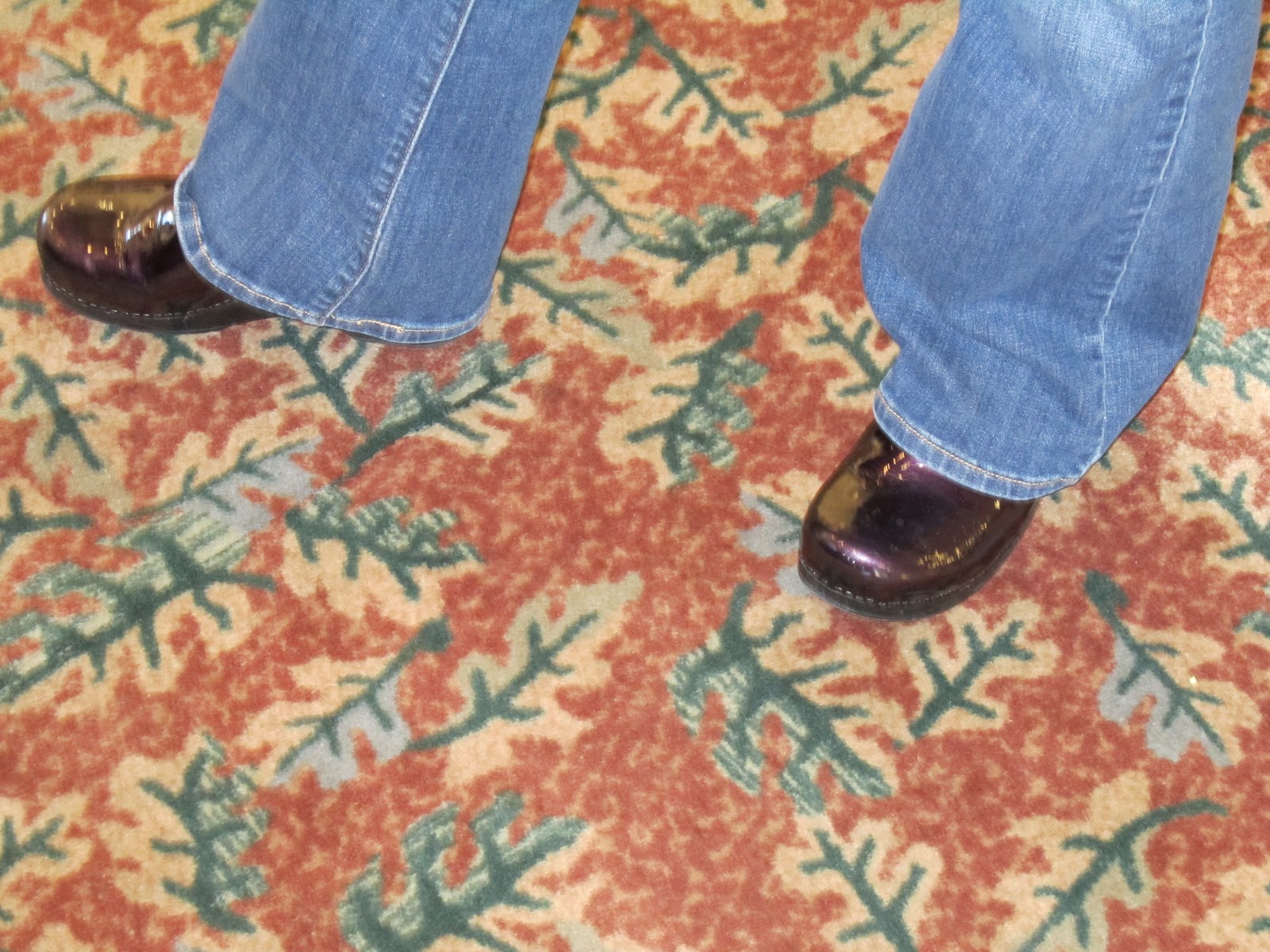
Though some of us do get a little crazy and wear shiny purple shoes...
ohh la la

24 September 2012

Confessions of a Grammar Ninja

I will openly admit that I'm really not a grammar ninja, but more of a grammar czar.  I choose not to use the term grammar Nazi - for one, I hate that term, and for two, I won't kill you if you use bad grammar, but I might try to banish you to Siberia.

Why this post today?  In a ten minute time span, I saw three different instances where people used then instead of than.  I was unaware that these two words were so difficult!  I get that people confuse there, their and they're, your and you're, accept and except, but then and than?  They aren't even homophones!

If you don't have to google the word homophone to continue reading this post, I love you.

Every morning when I wake up, I commence an inner battle: correct or not correct. As a teacher, I live in a very odd little world.  When I'm with students, it's my job to help them become productive, world citizens who don't sound like this guy.  When I was a classroom teacher, that was no problem - I spent the majority of my day working with kids, and since they're kids, I could correct their grammar with patience (usually) and understanding because they are/were kids -usually not old enough to vote or know who they wanted to be in twenty years. However in the library things are different (I bet you think you know where this post is going...I promise unless you know me well, you don't, so keep reading).

Now that I'm a librarian, I not only don't have as much time to help students with their horrific grammar and super smart comments, I am now often surrounded by adults with horrific grammar and super smart comments.  Back when I was teaching German, I could go DAYS without having to converse with or listen to dumb adults, now they come into my office looking for help all. the. time.  I spend most of my day helping adults with technology or listening (with a forced smile) to their opinions about books, libraries and the Dewey Decimal System (yes, we still use it. No, I don't know the exact number and classification for the random book you currently hold in your hand. No, I don't think it's outdated and I DEFINITELY don't think the IPAD CAN REPLACE A LIBRARY.  Sorry...rant over).

These days, I feel like I can handle the "super smart" comments with much more grace and patience than I can terrible grammar for two main reasons:  1. it's election season and everyone makes dumb comments about the candidate they adore/abhor. 2. Our media makes us stupid.  Don't even get me started - just watch as many episodes of The Newsroom as you can and we'll probably be on the same page. Love. That. Show.

But I'm still having a hard time with the grammar.  How is it possible that our generation grew up on grammar drills (sentence diagramming anyone? I loved that shit!) and most of us insist on using the word irregardless (I once heard a woman say "irregardlessly" and my head almost exploded)?  How can you be allowed to vote in this country if you say things like "Where's my phone at?" and use words like "excape" and "supposibly"?


Sometimes I'm pretty convinced that an intervention might be the only thing that can save me, but then I catch a glimpse of myself in  the mirror and remember that I'm so far from perfect, I really don't have the right to correct anyone...ever.  So I will continue to correct my students, and when I feel like it will be well received (a word I have struggled to spell correctly my entire life), I will gently correct my colleagues, friends, and family members.  Though I will say I have learned that correcting my sister's grammar will result in a sore arm from her punching me as hard as she can, and correcting my handsome guy's grammar will result in a deluge of nonsensical grammar-diarrhea that will make my head spin.

Just do me a favor: please remember that the words are disregard and regardless.  That's all I ask.


29 May 2012

Shelf Shopping and why I should do it more

In the three years I've been in the library biz, I've all but abandoned shelf shopping (it's like window shopping, only better, because it's books).  Now I choose books based on reviews in professional magazines like School Library JournalBookList, etc., as well as various book blogs (similar to this one, only WAY cooler) like Stacked. Admittedly, most of the books on my to-read list are YA, but I'm a YA librarian (a fact that will change in about a month...more to come on that later), so it makes sense that I'd read what my patrons are reading.  Because of all these recommendations, I rarely wander the shelves and displays at the library, looking for something to read.  However, a few weeks ago, I was forced to shelf shop for the first time in a very long time.  I say "forced" like it was torture.  Well, truthfully, it was and it wasn't.  The good news is, on that trip, I ended up getting a great audiobook.  The bad news is, I tried it again this last week and the results were so terrible, I abandoned the book and am now afraid of shelf shopping again. Crap.
I've forgotten what shelf shopping is like.  On the one hand, it's like an adventure: you have no idea what you're going to end up with, you just head into the stacks and keep looking until you find a book that intrigues you.  Often, your decision is based on cover art and the teaser (the summary on the inside dust-cover or on the back), and even as you leave, you have no idea whether you'll love the book or hate it.  It's exciting and exhilarating and, quite frankly, now that I've been on the other side, scarier than a Friday the 13th movie.
Until recently, I'd forgotten the power of cover art.  Now, when I get a book, I look at it and decide whether the cover art fits with what I already know about the book, and as I read the book, I look at the cover art and decide whether or not the cover art adds to the book or doesn't fit.  It has literally been years since I grabbed a book that I knew nothing about and decided whether or not to read it based on the cover art.  The same goes for the teaser: by the time I get a book, I've usually read a professional review or two, and/or had it recommended to me by at least one other librarian.  When I get a book and read the summary, I immediately look for the "hook" in the summary - something that will catch a new reader's attention - and as I'm reading, I try to figure out which kids would benefit from reading the hook, and which kids wouldn't.
Now that my shelf-shopping muscles have atrophied, going to the library to look for a book takes on a whole new level of...gahhh.  I look at the covers of books way too long, trying to find hidden clues about the book, and I read the teaser 18 bazillion times wondering why there's so little information!  Clearly, my job has dimmed the magic of finding books. And that's sad, because, well, I'm a librarian, and I'm all about the book magic.  So I've decided I need to get the magic back.
So now I have to start thinking about shelf-shopping like a patron.  Being a librarian, I'm not afraid of libraries, I can usually figure out where things are pretty easily on my own, etc.  So my comfort level in libraries made it easier for me to be a shelf shopper - I loved wandering the stacks, looking at the displays, trying to find that next great read about who knows what.  In fact, I used to follow the library volunteers when the were shelving and try to grab books that had just been turned in.  I figured if someone else checked it out, it had to be good (incidentally, that's how I first came across Danielle Steele.  At age 13. Wowza.).  But not all library patrons are comfortable in the library, and not everyone has the time to wander the stacks and go on a book safari.  So if I were a patron, making a quick stop to find a book, or maybe I'm not terribly comfortable finding books in the library and, like my sister, am afraid that wandering the stacks would get me lost in the labyrinth of the library, causing the secret library cult to come out and force me to join, making me a crazy library nerd (no joke, she thinks we have secret handshakes and take blood oaths), how would I pick a book?
And as a librarian, how do I make sure the people who aren't book-finding-pros find books?
Well, for all of you non-book sleuths out there, here are my suggestions:

  1. Don't be in a hurry.  Give yourself some time to look at books, read the teasers, etc.  But if you are in a hurry, just head for the new book display or...
  2. Ask someone who works in the library for a recommendation.  Most people who work in libraries are readers, and they might have a suggestion or two.  Be prepared though, they won't just look at you and say "read this".  If they're worth their salt, they'll ask you about other books you've enjoyed or the genre/type of book you're looking for.
  3. If you're looking for a particular genre, look for the genre stickers on the books (something I used to HATE but now love), or...
  4. Use the OPAC - online catalog.  You can search for books by genre, author, similar author and similar title.  If you just finished reading Old Yeller and loved it?  Search for other books by Fred Gipson, or type in "Old Yeller" and then find the "similar titles" tab and click there.  This will give you a list of books that are similar either in genre or writing style.  This is also something you can do from home, when you have time.  AND you can put books on hold, so that they're ready the second you walk in the door! Yeay!
So what have I learned?  For one, I know that I need to practice my shelf shopping skillz.  I shouldn't be afraid to shelf shop! My insider knowledge of books has made me too critical of cover art and teasers.  I don't know if I'll ever be able to look at books with a non-librarian eye ever again, but I'm going to try.  With that, I bid you adieu and am headed to the library to just wander.

Happy reading!

15 May 2012

Article Review - TIME Magazine and Parental Guilt


Courtesy of Time.com

I've never blogged about a newspaper/magazine article before, but the cover of last week’s TIME magazine sparked such a discussion, that I was not only intrigued, I couldn’t wait to read the article.  The only problem is, now that I've read the article, I REALLY don't know what to think. I was offended by the cover for oh-so-many reasons, and now that I've read the article, I'm even MORE offended by the cover and a little confused.
For the record, I do not have children.  So if the fact that I am going to comment on what I know about breastfeeding and raising children without any first-hand experience (other than helping to raise my nieces, nephews, etc.) will offend you, thanks for stopping by, but you should probably stop reading now.
Let’s start with the cover, since it’s the what got me going.  My brain tells me that the cover is meant to be shocking.  TIME has done this in the past (here’s the cover that creeped me out so much I tore it off the magazine), and because the article is technically about extreme parenting, the cover should be extreme right?  The only problem is that in this case, the cover feeds into some misconceptions about breastfeeding.  Last week Facebook, Twitter and my RSS feed were absolutely buzzing over the cover – even before people read the article.  Comments ranged from breastfeeding a 3-year-old borders on child abuse and she’s too sexy to be a breast-feeding mom to that kid is totally going to show off this picture when he’s high school and his buddies are going to be jealous.  I’d say 90 percent of the comments were, in my humble opinion, asinine and uninformed.  Regardless of the shocking nature of the cover, I have to say I think TIME took it too far, only because I think this cover will now be fuel for the idea that breastfeeding is “weird”, even though all obstetricians out there would say that breastfeeding is beneficial.  And I doubt that most moms breastfeed their children using a stepstool.  Just sayin.
However, what REALLY bothered me about the cover was the caption: “Are you Mom enough?” It suggests that mothers who aren’t willing to go to extremes – like breastfeeding to the age of 3 or older – for their children are terrible mothers.  And that, even though I’m not a mom, offends me right straight down to my core.  I know some women who were able to breastfeed their children for over a year, and I commend them for that.  I also know women who wanted to breastfeed for longer than they were able and were absolutely tormented by their inability.  We’re talking 2am bawling phone calls about being inadequate mothers simply because they couldn’t produce enough milk.  I also know mothers who physically can’t breastfeed – take, for example, my dear friend Adi, who just adopted a sweet little girl.  Is Adi to believe she’s not “mom enough” because after years of trying to get pregnant, she now has a beautiful daughter she can’t breastfeed? 
Sorry TIME, but I think the cover takes it a little too far to the extreme.  I truly believe the article would have been well read and copies would have sold even if the cover hadn’t been so provocative.

Now for the actual article itself.  For one, it's really not about breastfeeding at all.  It's about Dr. Bill Sears and attachment parenting.  Yes, breastfeeding is an important tenant of the attachment parenting movement, but it’s not the only tenant, AND it’s barely mentioned in the article! The article actually focuses more on sacrificing for one’s children and the author seems to take more issue with the idea of co-sleeping.  In fact, it’s pretty clear that the author thinks Dr. Bill is crazy and attachment parenting is extreme, even though Dr. Bill even says himself that parents should do the best they can with what they have.
From what I know about attachment parenting, I think the ideas are great, but just like anything associated with parenting, it can lead to massive amounts of parental guilt.  I think that’s what bothers me the most about this article and the cover.  I have seen moms racked with guilt over things like letting their kids watch TV or have chocolate after dinner. TIME attempts to address this with a little inset about “detachment fathering”, but unfortunately, this little snippet angered me just as much as everything else.  The author, Nathan Thornburg, is basically telling dad’s that it’s OK not to feel guilty if you don’t do as much as your child’s mother because attachment parenting really is all about ‘attachment mothering’.  I agree with the idea that parents need to work to “distance themselves from the expectations set by everyone from Sears to your peers in mommy-and-me-yoga”, but I don’t agree with the idea that it’s ok to slack off as a parent because “children can – and often do – get by without a father in their lives at all”. That’s a steaming load of crap if I do say so myself.
In the end, I think TIME intended to bring light to a new trend in our society, but all they’ve successfully done is add to the unbelievable guilt that parents face each and every day.  Usually, I can stomach what TIME puts out there – mostly because I’m aware of the slant they put on things.  However, this slant is too much for me. I think of all the amazing moms that I know out there and my heart breaks for them - reading a magazine shouldn't add to guilt feelings!  So TIME, in my humble opinion, you really missed the mark on this one.

11 May 2012

Lunch with the book thieves

This week at school we have not only celebrated/honored Teacher appreciation week, we've also celebrated/honored National Children's Mental Health Awareness Week.  The theme for this year's NCMHAW is "Heroes for Hope" - an effort to honor the adults who care about young people and help them emotionally work through trying times and encourage them as they grow into mentally healthy adults.
This year - especially this spring - has been very trying mentally and emotionally for our school, but we've come through it with flying colors.  We have proved that as a school community we are strong, we care for each other, and we can succeed and flourish even when things are terribly difficult.
So today was a special day at school - it was Super Hero Day!  There are many people out and about sporting Batman t-shirts, Superman capes, etc. etc.  Originally, I was planning to come to school dressed as the library ninja that I am - I thought it would be cool to sport my "other uniform" at school.  However, something amazing happened yesterday at lunch that caused me to completely abandon the library ninja and spend about 50 minutes last night creating super hero costumes for myself and four of my students.
I have a group of students who come in and have lunch with me every day.  To an outsider, they would probably be considered "book nerds", but to me, they're awesome.  Its a group of girls who are unique, intelligent, funny (sometimes ridiculous) and caring.  Last year we met after school as a book club.  This year, after school didn't work so great for me because of my athletic director duties, so a few of the girls started coming in for lunch a couple days a week, and now it's a daily thing.
We talk about any and everything.  Today, the main topic of discussion was the very controversial cover of TIME magazine.  They don't know much about breastfeeding, so we talked about what each of us knew, someone jumped on a computer and googled it, and we discussed what we thought about breastfeeding and the cover as well. Our discussions have ranged from the deep and intellectual (how do we make education better) to the downright silly (how do we survive the zombie apocalypse).  Yesterday they came in wondering why today was deemed "Super Hero Day".  So I explained it to them, and we talked about who the "heroes" in our world are.  One of them said I was her hero because I'd introduced her to so many books that had helped her see the world differently (*sniff* is someone cutting onions in here?!?). The girls joked about dressing up as me, and one girl asked me "What does a book super hero look like?"
My response was oh so intelligent: "Uh, I dunno."
So we stared talking about what she would look like, and someone said she looks like the book or character that has most inspired her.
In case I haven't said it eighty million times, one of my favorite books ever written is The Book Thief by Markus Zusak.  And yes, the entire lunch group has read the book and five out of six loved it.  So long discussion short, we decided to come to school as:

The Book Thieves!

You might be asking yourself, what exactly a "Book Thief" is, and how in the world someone named "thief" could be a hero.  We talked about this yesterday and again today.  The Book Thief is about Death, and his experience following a little girl named Liesel Memminger and his various encounters with her throughout WWII.  So our "super powers" as Book Thieves is the ability to see people as they truly are - just like Death can.  One of my girls also noted that this fits in well with NCMHAW because if we can/could see people as they truly are, we would be more able/willing to help them if they need it.
You might also be wondering about our costumes.  Lemme 'splain.  See, the cover art (er, one of the covers) features white on black dominoes, so we decided to put dominoes on our shirts.  Originally, we were going to do white on black dominoes, but half the girls didn't have white t-shirts, so we switched the colors.  The capes are a)awesome and b) to represent the different colors each person sees when Death comes to collect them (pg 4).
 As my time here winds down and comes to an end, days like today are extra special.  I know that I will miss the staff and the students here immensely.  I will miss these young women who make me laugh, drive me crazy and help me be the best teacher I can be each and every day. My office is littered with their books, lunch sacks and the sweet little notes they leave regularly on my desk/computer...


and when I have moved to be with my guy and am (fingers crossed) working in another library, I won't forget the day I was able to be a super hero with some of the brightest students around. I'm blessed. Really, truly and deeply blessed.


01 May 2012

If Julie Andrews had been a librarian...

Today I read a post by "The Mighty Little Librarian" Tiffany Whitehead about the power of recommending books to kids.  She apparently has the same super power that I strive for: the ability to recommend the perfect book to each and every reader.  While I don't do it as well as she does, I do know that my students have learned to trust me and my knowledge of YA lit. And I also agree with her about the responsibility school librarians have to stay up with trends and popular books in the world of YA lit.
Here's her post - take a gander at it, she really knows what she's talking about:

The Power to Recommend


Her post got me thinking about my job (again) and what I do every day.  More than recommending books to students, I love love love it when a student comes in and says "I loved that book!" or even "I hated that book" because it gives me a chance to get to know my students more.  Being out of the classroom, I no longer have the opportunity to get to know students as well, so these interactions make my day each and every day.
But recommending books isn't the only thing I love about my job.  I love lots of things about my job (don't worry, there are things I hate too, but Julie Andrews never sang a song "These are a few of my most hated things", so there won't be a post about that...).  When you add my love of my job to my love of all things Sound of Music, you come up with the following song:

Research on laptops and sparkly brand new books
Prezi and Wordle and novels on new Nooks
Meeting with book club and writing reviews,
This is why library peeps do what we do!

And THAT took me about 30 minutes to come up with, so that's all you get.  It's just further proof that I was never meant to be a rockstar.

If you've ever wondered why someone would ever become a librarian, please see my recent post about what librarians actually do every day, and realize that those of us who work in libraries do it not (just) because we're book nerds, but because we love books, reading, information and finding ways to connect our patrons - in my case students and teachers - with the books and information they need.

25 April 2012

How my high school math teacher made me a better librarian

No, this isn't a book review.  But it is an awesome story followed by a bit of a rant...er clarification about what I do every day.

When I decided to become a librarian a few years ago, I never knew I would need math in order to do my job, and most of the time I don't.  However today, a group of girls today were discussing how to solve a riddle, and I helped them solve it using MATH.  Yep. Math.  More specifically, Algebra...the bane of my high school existence.  And the most amazing part is, I hate math.  In general, math confuses me and if you asked me to add two numbers bigger than 12, I'd probably say 7. 

Here's the riddle: How old would you be if two years from now you will be twice as old as you were five years ago.
The girls were trying to figure out the problem by randomly picking ages and seeing if it worked.  When I walked by, they asked me if I knew the answer and I said "Uh, if it involves math, I have no clue", but as I walked away, I was filled with the spirit of my high school math teacher Mr. Thomas, and I remembered how to figure it out.  Here's what I did...


When I was done, the girls were in awe.  Then they asked me how I had done it so I had to go back and explain it, so I did.  And I was so excited that I'd figured it out and been able to explain it, that I did a happy dance.  Then I went and found some math teachers to show off how smart I am.

I'll bet you're asking yourself why I would blog about my mad math skillz.  Well, it's simple.  People ask me all the time what exactly it is that I do every day, and I would love to educate the world on the fact that librarians are more than just book nerds, and we do more on any given work day than just put away books and shush people.  I've been asked so many times what it is that I do, I'd like to take a minute to tell you what I do every day, and maybe dispell some age old librarian myths.
Let's start with the myths about my job.  Here are some of the most common questions/comments I hear that drive me crazy.
  • "Do you know the Dewey Decimal System by heart?" Heck no.  I don't even think Melvil Dewey knew the whole system.  Actually he couldn't have.  I do know more about the DDS than most people, but it doesn't mean I think in Dewey.
  • "You are too loud to be a librarian." Well, I am loud.  But my library isn't a quiet library either.  I work in a middle school, and ask any parent, 12-14 year olds do not know the meaning of the word "quiet".  The truth is, libraries - at least public and school libraries - really aren't "quiet" places anymore.  They are places people go to find information, and finding information isn't always a quiet endeavor.
  • "You're too young/sarcastic to be a librarian".  Whatever.  This statement means that all librarians are either stuffy old ladies, or Bill Cosby.  Librarians in general are younger, hipper and wittier than Marion the Librarian ever was.
And the last question I get is the one I'd really like to try to explain, though if I answered it completely, this would be the world's longest post.  The question I hear most often is "What do you do all day", and the simple answer is A LOT.  But instead of giving you a rundown of what I do every day, I'll tell you what I spend the majority of my time doing.  It's pretty simple.

I teach kids (and teachers) how to find answers to questions, how to find information, and how to find books they want to read.  I teach kids how to solve problems using their brains, the internet and print materials. I train students to know that the answer to their question or the solution to their problem is out there, and then I give them the tools to find it.

And today, I taught a group of kids how to solve a riddle using algebra.

Who wouldn't want to do my job?

03 February 2012

Books, Steampunk and Bonding with Students

I don't usually blog about what I do every day in the library because non-library people would probably find it pretty boring.  I read*.  Books, book reviews, magazine articles about books, books about books, etc.  And I talk about books - with teachers, students, and other library geeks.  I do book talks, genre walks, book recommendations, etc.  At least once a day I go gaga crazy over a book.  Usually, it's when a student comes in looking for a book and I get to help them find one that's AMAZING and that they cannot possibly live without reading it!!!  And yes, most of the students and staff here think I'm a little off my rocker.  They're probably right, but I'm charming and cute, so they let it go.
The teacher part of me has not died in becoming a librarian.  One of the biggest perks of being a teacher is watching young minds grow, change and develop into thinking (albeit hormonal, slightly imbalanced, but darn funny) minds.  The thing I miss the most about being in the classroom is the opportunity to get to know students - their lives, their strengths, their struggles, and their passions.  As a classroom teacher I really got to know the kids in my classes, but I never really learned much about the students who didn't take German.  As a librarian, I learn lots of names but I don't have as much of an opportunity to get to know kids on an individual basis.  Except for two types of kids:  the book lovers and the punks.  I know the punks because I have to talk to them every time they come into the library about one of the following things:  drawing on the desks/walls/bookshelves, horseplay, trying to check their facebook status, swearing, or being punks.  I had to deal with the punks as a classroom teacher as well, so it's par for the course.  And usually, I can find one or two redeeming qualities to the punks, so they aren't that bad.
However, it's the book lovers that make my job a joy each and every day.
Take, for instance, the three girls who come in and have lunch with me every day.  They love books just about as much as I do and we banter about books constantly.  If I read a book that I know one of them will enjoy, I give it to them.  One of them constantly tries to convince me that there is literary value to Nicholas Sparks novels (professionally, I know she's right, but personally...gag me). Another devours every book i give her within 24 hours and always give an honest opinion about books (last week: "Only babies would like that book Miss C...what were you thinking?").  Those girls make my day each and every day - even on days when they're hyper and loud.
This morning I visited some 6th grade classes and talked about different book awards, the awards process, and the award winners we have in the library.  As I was getting ready to leave, a boy caught my attention: "Miss C...look!!" I turned, and in his hands he held the perfect Steampunk tophat and goggles.  I melted.  This kid knows I LOVE Steampunk (if you don't know what Steampunk is, think Will Smith's Wild Wild West.  It's technology + historical fiction = pure awesomeness), and now we're permanently bonded through the love of a genre.
I don't know where life will take him, who he'll turn out to be, or what books he'll love as an adult, but I do know that we've bonded because of books.
Some people are super stoked for this weekend because of the Super Bowl, and that's great for them.  I am super stoked because sweet Abram brought his rockin' cool hat and goggles in to show them to ME today.  That?  Makes me pretty freakin' cool.

*Update: I also spend quite a bit of my day focused on technology - fixing it, teaching it, figuring it out.  I'm as much tech-guru as book-guru.  Beloved library friends, please stop the influx of emails about "don't you work with technology?" and "gosh, I wish I had time for books - I'm too busy with technology".  Books are just the focus today.  For the record, I heart tech too.

12 January 2012

The Power of a Good Book

For Christmas this year, my dear friend Kami gave me this necklace.  To most people, it would just be a pretty necklace.  But for me, it's one of the most amazing gifts ever.
As soon as I saw the necklace, I said "Ohmygosh, this reminds me of Revolution!"  Kami hadn't read the book, so I - of course - had to give her a rundown of what happens and why it's so amazing.
Yes, I'll admit that most people have not achieved my unbelievable level of book-freakishness, but I know I'm not alone in relating certain things in life to the books I've read.  I make obscure book references often.  I try to keep those references in my head unless I’m fairly certain those around me will catch on to the reference.  I don’t want everyone to know the true level of my book-weirdness.  But I digress…
When we read a book that moves us, it sticks with us, and even though we may not think about that book or character for a while, it only takes a little push, a little reminder, to shoot us back into that world.  This morning, as I was putting this necklace on, I remembered Andi’s voice: her bitterness, her pain, and her absolute obsession with a secret diary that made her feel crazy and, ultimately, helped save her.  I know that I have read books that make me feel crazy while I’m reading them – whether it’s because of the pictures I create in my head (Coraline by Neil Gaiman took my fear of rats and crazy mothers to a whole new level) or because of the emotions they stir up in me (please, please read A Monster Calls by Patrick Ness if you like to be moved by literature.  Or read Revolution! Both will rock your socks, I promise).
Regardless of why and how the book moves you, the important thing is that you are moved.  As a librarian, that movement is one of the many things we strive for.  Even though the library isn't just about books anymore, and sometimes in a school library, we spend more time focusing on technology, 21st Century Skills and research, we still love to see students absolutely engrossed in books, we love it when they come in raving about a great book, and we really love it when they connect a great book they've read to something as obscure as...a necklace.  Even though we do so much more than just book talks, we still want every patron to find books that make them feel, or forget the world around them for a little while.  And that, my friends, is the power of a good book.

Happy Reading!

09 September 2011

7 Books that Changed the Way I See the World

After reading this post on Bobbi Newman's blog, and then reading the original post on The Happiness Project, I decided to create my own list.  Only it turned out not to be as easy as I thought it would be.  Answering the question "What is your favorite book" is difficult because I love lots of books.  But answering the question "which books have changed the way you view the world" is different.  It doesn't mean I had to like them - they had to change how I saw the world around me.  So here my list in no particular order.


1. The Power of One by Bryce Courtenay:  I know, you're probably thinking get over this book already lady!!! But it really did change the way I viewed myself, the world, and reading.  PeeKay doesn't set out to change the world around him, but he does.  I learned that all of our actions have an impact on the world around us - an impact that often we can't control.  I also learned that the only way to accomplish anything is to be yourself.  And, as I stated in this other post, I fell in love with reading through this book.  This was the first book I ever read multiple times, and it is one of the few books that I will continue to read throughout my life.


2. Lamb by Christopher Moore:  Though I read this book long after my view of the church and God had gone through some major changes, I loved this book.  To me, this is what Jesus' life would have been like - kinda.  I don't think Jesus did it all by himself - I think He had friends who supported, helped Him, and challenged Him when He wrote the beatitudes (my FAV part of the book).  And by friends, I don't mean the Disciples.  I mean He had a BFF like Biff.  The truth is, no one knows what happened during the 30 years of Jesus' life when nothing is written about Him, but I like Moore's take on it - that He struggled, whined, got annoyed with the Disciples and eventually came to His senses and did what needed to be done.  Though this book is completely irreverent, I loved it, and it helped me see Christ in a more human light. 


3. The Alphabet Versus the Goddess by Leonard Shlain: another book that challenged what I believe.  This book was given to me by one of my mother's childhood friends.  I grew up seeing her not often, but always enjoying being around her even though I thought she was a kooky feminist.  Before I read this book, I'd never considered the differences between how men approach the world, problems and issues versus how women do, and I'd never considered that there could be factors in society that would shape the way we view women.  When I started reading the book, I wanted to disagree with it, hate it and dismiss Shlain's claims as "kooky" and, well wrong.  But man he makes a compelling argument and it makes sense.  I've never viewed feminism or reading in the same light.


4. The Unbearable Lightness of Being by Milan Kundera:  this was one of the first books I picked up of my own accord and absolutely positively hated.  Ugh, it was awful.  It depressed the crap out of me, and I felt like the characters in the book were truly miserable and just wanted everyone to be miserable with them.  I don't want anyone to be miserable, but most of all I don't want to be miserable.  I knew after reading this book that life is entirely too short to ignore or not deal with depression - a piece of wisdom that has served me well in life.


5. A Dog's Purpose by W. Bruce Cameron: have you ever read a book that makes your soul smile?  What an amazing book.  I am a dog lover, and I've read just about every book written from the point of view of a dog (including The Art of Racing in the Rain and A Dog's Life), but none of them even come close to this book.  We all know the human reasons for having a dog, but this book made me see the world from my dog's perspective - why are dogs such great companions?  And why can't they put the damn ball down?!?  I look at dogs differently now and, honestly, I love them more after reading that book.


6. Die Entdeckung der Currywurst by Uwe Timm: this was the first book I read in German that was not translated from English.  When I lived abroad, I felt that it was important to immerse myself in the language - including in my reading.  But reading original German texts was difficult because every culture has its own accepted writing style (anyone who has read The Girl with the Dragon Tatto knows that in Sweden, starting a book of with 80-100 seemingly pointless boring pages makes for a best seller), so I found myself reading tons of Nora Roberts books because the layout was already second nature.  When I read Die Entdeckung der Currywurst (the discovery of the curried sausage), it was like the language - and to some degree - the culture clicked in my head.  I wasn't stumbling over passages anymore, and I began to see how the culture is reflected in the writing style, but that's another post for another day.


7. The Omnivore's Dilemma by Michael Polan: I love food.  I love eating it, sharing it with loved ones and preparing it.  This book changed the way I view what I put in my body and how it affects the world around me.  I won't even attempt to claim that I am now a locavore who despises all things fast food (thank you to my dear sister who cured my doldrums today with a Wendy's lunch of awesomeness...sorry Mr. Polan), but I will say that I am more food conscious now and I make more of an effort to buy local and stay home and prepare fresh meals when I can.  The saddest part about reading this book is my changed view of corn - it's no longer an exotic vegetable that I only get in the summer when my favorite Olathe sweet corn is in season.  It's everywhere, all the time in everything.

Which books have you read that have changed your world view?

23 August 2011

August books...

I recently finished another amazing book (no spoilers here) and came to my blog to write the review and realized that I hadn't published a single review yet this month!  What the...?

So once again, just wanted to let you know a few things:

  1. I have been reading.  Lots and lots.  Oodles and oodles.  I even gave up movie time with my guy last weekend to read (in my defense, he was watching Beavis and Butthead).
  2. I have been writing reviews, I just haven't finished any.  I get about 1/2 way through the review and something comes up so I save it to be finished later but then later never comes...
  3. I GRADUATED!!!!  Pretty soon I'll be a full-fledged librarian.  But the best news is I don't have to take any classes this semester!  Wahoooo!
  4. School is about to start, so yeay! And boo...because there goes my free time.
  5. I promise to have at least 4 reviews up by the end of the month.  I promise promise.  Two of them are going to be AWESOME because I've just finished reading some truly awesome literature.
  6. Book Club Ladies - I'm coming back someday, I promise.
Oh, and if you have read any good books lately, please let me know.  I'm looking for recommendations for adult books.  Now that grad school is over I feel like it's going to be completely acceptable for me to read some adult books now and then.

Happy Reading!
Suzanne

30 July 2011

What Kind of Reader Are You?

As many of you know, I read.  Often.  Entire 8 hour spans with nothing more than a pause to use the bathroom (or to let the dogs use the bathroom).  In fact, today, my guy suggested that I go shopping instead of sitting at home all day reading, and, well, I'm still in my work out clothes (at least I did that today!).  In the rock-paper-scissors world of reading vs. shopping, reading beats shopping every time.  (Shopping beats cleaning, but cleaning does NOT beat reading.  I don't think anything beats reading...)

But what do I read?  And how do I choose?  What kind of reader am I?

In order to explain what kind of reader I am and how I choose the books I read, I need to give you a little history about my life as a reader.  So grab a cup of cocoa, a snuggly, and enjoy.

When I was little my family would watch TV together in the evenings.  After about an hour of Murder, She Wrote, my dad would usually move from the front couch to the back couch and open a book.  I think he wanted to spend time with us but just wasn't all that interested in TV (to this day it's pretty difficult to get him to sit through an entire movie).  As a daddy's girl, I often went and sat with him.  And since he was reading, I had to as well.  I brought my library books out and sat next to him while he his books.  Then one day, I was probably about 13, he finished a book and handed it to me.  I wish I could remember the title - all I know is the cover was blue and it was a mystery novel.  And it had the "sh" word in it!  I felt soooo mature.  From then on, if Dad thought I could handle the book, he'd give it to me when he was done.  If not, he put it in the basket (and I always raided the basket when he wasn't around).  And any book my dad liked, I had to like.  One day he handed me The Power of One by Bryce Courtenay.  I started reading it and hated it.  But I didn't want to admit that to my dad, so I avoided reading it or talking about it.  When it became obvious that my dad loved the book and was dying to talk to me about it (he's Italian and prefers silence, so when he wants to talk, you talk), I picked it up again.  Once I'd struggled past the first 80 pages or so I couldn't put it down.  I literally fell in love for the first time.  I felt like the words had power, I wanted to be PeeKay and I really REALLY wanted to work in a coal mine with a big Russian guy (ironic that that part isn't the most important part of the book, but I have loved mines ever since).  That book changed my life, both how I viewed myself and my talents and abilities, and how I viewed reading.

I often look back at that experience and wonder who I would be if I hadn't read that book - both as Suzanne the semi-normal woman, and as Suzanne the reader.  What it did for Suzanne the person is show me what self confidence is, about the effects of our actions, and why it's important to never give up.  For Suzanne the reader, it made me unable to put a book down until I've read it cover to cover, and it expanded my "reading comfort zone".

So what type of reader am I?

I'm a slow reader.  I like to re-read passages that are particularly well worded, or go back and find the clues in a mystery.

I enjoy all genres.  Some more than others, but I have read books of every major genre and enjoyed them all.

According to my mentor, idol and friend Di Herald, I prefer literary fiction (books that don't have clean "happy for all" endings).  I think this stems from the fact that life rarely has fariytale endings.  I'm aware that books don't have to be realistic, I just like them to be a little realistic.  I think reading too many romance novels gave me the wrong idea of what love looks like, so now in my old age I'm a bit...skeptical?...of books with shiny, happy, perfect endings.

I don't get graphic novels.  If the mystery clues are written out, I can solve the mystery in 90 pages (usually).  If you draw it out, I'll miss the clues every time.

I now read every single book from the point of view of a book-recommender/librarian.  Whenever I finish a book, a list of names of people and students who would like the book pops into my head.

I am a reader that refuses to purchase books.  The only books I have actually paid for with my own money in the last two years are either absolute favorites, gifts or textbooks for grad school.  Find your local public library and use it.

I choose books based on recommendations from other librarians, friends, family or reviews I read.  The list of books I want to read is so long I stopped keeping one.  If I see it or hear about it more than once, or if it's on the bookshelf as I'm walking by in the library, I read it.  I always welcome recommendations, though I think the public library would prefer that I didn't - my request list is a mile long.

If I start a book, I have to finish it.  There are very few exceptions to this rule.  If I consider putting a book down, I remember The Power of One and keep reading it. Though you'll be happy to know I have learned that it's OK for me to not like a book my dad recommends.

I love YA Lit and am darn proud of it.  I don't care if you think it's silly.  Read this article by Gretchen Kolderup and you'll understand why.  "But even if I were to switch careers, I would continue reading YA Lit because it’s good."  I agree with her completely.  Kolderup does an amazing job of explaining what YA Lit is and isn't, but I think it is sufficient to say simply, YA Lit is good literature, reagardless of your age.  My one soap box for this post is this:  if you think YA Lit is just for teens, you're absolutely wrong.  Email me, I'll chat with you about your likes and dislikes in reading and prove to you that there are equal numbers of YA Lit and adult lit books that fit your taste.  And parents, if you have kids, get over it and start reading YA Lit.  These books are not only interesting, they contain big issues that you can discuss with your children.

So what kind of reader are you?

21 July 2011

Books: A Love Letter by Bobbi Newman

I've realized a few things this week.
  1. Most people don't read as much as I do.
  2. Most people find the amount of reading that I do a little weird.
  3. Some of you following my blog think I'm "making up" the number of books I read (wha?)
  4. There are more people reading this blog than I thought (wahoo!).
I realized all of this because of a comment someone made about my blog.  It went something like this "You really read that much?  Wow.  That's like, a lot."  When I mentioned this to someone else, they agreed.  Then along came this wonderful little posting by Bobbi L. Newman.  It basically summed up exactly how I feel about reading.  It is beautiful, insightful and dead on.  It's called Books: A Love Letter.  Please take a minute to read the entire text, but here's one of my favorite parts.

Books have transported me to new and different worlds, or just made me reexamine the one I live in. Books have helped me take a break when time were hard or escape when times were just down right awful. I’ve learned new lessons and re-learned old ones, some good, some bad: good doesn’t always triumph over evil, the good guy doesn’t always win, the bad guy doesn’t always lose, true love conquers all, there is no right or wrong path just the path we take and its up to us to make the best of it.

The only thing I would add is that if I could bottle and sell the way reading makes me feel, I'd be a millionaire in an instant

Thanks Bobbi, for attempting to put to words what many of us feel.

17 July 2011

Prepare yourselves...

Just a quick little note to let you all know that I am finally back from Europe and I have about 8 books to review.  So if you've subscribed to this blog (all 4 of you!) then be prepared your inboxes for a whole lot of information coming from Suzanne - hopefully most of it is welcomed!


Here are the books/topics I plan to cover in the next few days:


If I Stay by Gayle Foreman
Incarceron by Catherine Fisher
What makes an audiobook worth listening to?
The Freak Observer by Blythe Woolston
XVI by Julia Karr
Wicked Girls by Stephanie Hemphill
Five Dysfunctions of a Team by Patrick Lencioni
What kind of reader are you?
Saving Fish from Drowning by Amy Tan
The Bookseller of Kabul by Asne Seierstad
True Vision by Joyce Lamb
Why I've never read Harry Potter, and how I live with myself.

Yes, some of the books I've recently read are older, but, as Linda Holmes pointed out in her article, it's impossible that we read everything ever written, so I'm OK with keeping books on my to-read list for longer periods of time and getting to them when I have a minute.  And since taking books to Europe is a heavy endeavor, I decided to take paperbacks I'd had for some time, read them while there and then gift them to my German friends.

16 May 2011

The Future of Libraries and How Seth Godin Proves He's Never Been In a Library

So honestly, I’m kind of shocked that this is my second non-book post in the last week, but this blog post ticked me smooth off (as my friend MattFrye would say).  Clearly, Seth Godin has not actually visited a public or school library recently, or had a conversation with a librarian.
One of the biggest pains of my job is explaining constantly what I do.  I understand the necessity of explaining myself because the role of librarians has morphed completely in the last decade.  Also, I find that I have to explain my job to people who either don’t use libraries or don’t have school aged children.  People who visit the public library know what my job entails, and so do parents.

So here’s why I take issue with what Godin said.

First, I’m appalled at Godin’s definition of the librarian of the future, not because of what he’s asking of us, but because we already do all that stuff.  We teach people how to use the information they find to create new and innovative products, ideas, you name it.  We teach people how to critically think and how to be information literate – which is a term that means they know how to identify, locate and use the information they need to complete any task.  Again, it is clear to me that Godin has not visited a public or school library recently.

The next library is ...a place where people come together to do co-working and coordinate and invent projects worth working on together. Aided by a librarian who understands the Mesh, a librarian who can bring domain knowledge and people knowledge and access to information to bear.

That’s what I do each and every day, and if you walk into the Mesa County Public Library, you’ll see the same thing.  Just look at their list of events and classes offered, and you'll see that the library is a place where people and information come together to form ideas.  Libraries and librarians bring information and people together constantly.  All. The. Time.  And they do it with a smile on their face and more patience than Mother Teresa (ok, maybe that’s a stretch, but they have lots).
Second, Godin’s reasoning behind not needing a library for research is…well, you decide.

Wikipedia and the huge databanks of information have basically eliminated the library as the best resource for anyone doing amateur research (grade school, middle school, even undergrad). Is there any doubt that online resources will get better and cheaper as the years go by? Kids don't shlep to the library to use an out of date encyclopedia to do a report on FDR. You might want them to, but they won't unless coerced.

 There’s a part of me that doesn’t feel the need to respond to this statement because it’s clearly...uh…uninformed (he must have gotten his information from Wikipedia…).  Wikipedia has eliminated the library as the best resource for research?  Ha.  Double Ha.  In fact, I actually have to fight to get teachers to allow their students to even use Wikipedia as a starting point.  Wikipedia is not considered a valid or reliable resource by most (though it's proving to be more reliable than it used to be) and no one doing any sort of research – amateur or otherwise – should use it as their only source of information.  While he is correct in that most students won’t come to the library to use an out of date encyclopedia, they will come to the library to use an online one, or any other of our many online databases, or to use a web-based tool to present their information (like Glogster, Prezi, Animoto, VoiceThread or Xtranormal – any of those tools ring a bell sir?  No?  Go ask your local librarian, he or she will know).  Unfortunately, many of the free online resources are being overrun with advertising, and other quality online resources – like databases – aren’t getting cheaper.  School districts are being forced to purchase fewer and fewer.  Thank goodness the public library still purchases enough so that patrons can conduct meaningful research.  Also, I’d like to extend a friendly challenge to Mr. Godin.  I’d like for him to come in and teach one of my classes how to use Ebsco or another database.  It’s not that easy.  So the truth of the matter is, using Google or Wikipedia might be easier but definitely not better.

Truth be told, I wonder if Mr. Godin’s opinion would be the same if he made less money.  I know that sounds a little harsh, but I wonder if it’s true.  Let me put it to you this way.  I read about 2 books per week, that’s 100 books a year (at least).  Many of these books are new releases, so they’re still hardback.  But in order to make a conservative estimate, let’s say I only read paperbacks.  Books alone would cost me about $1000 a year.  I watch fewer movies – about 1 a week.  But at $12 a pop, movies would cost me about $625 a year.  That’s $1600 a year that I save by going to the public library.  That’s about $130 a month I save, and I’m single and childless.  Imagine how much money a family of four would save.

Godin also talks about the Kindle and ebooks.  Quite frankly, this goes back to my thoughts that he’d be singing a different tune if he lived paycheck to paycheck. “An ebook costs about $1.60 in 1962 dollars.”  Uh, $1.60 was a LOT in 1962 – a gallon of regular gas cost a mere $0.31, so an ebook would have cost you the equivalent to 5 gallons of gas.  If I re-figured the amount of money I save by visiting the public library based on this figure (each book would cost me approximately $20), I’d spend over $1900 on books alone.  Now I know lots of people who buy books for $20, and I don’t think that’s a bad thing.  My whole point in making the comparison is the simple fact that in these economic times not everyone can afford to buy books, ebooks or DVDs.  I feel like the tone of Godin’s article was a little condescending to people who struggle financially.  Luckily for everyone (Mr. Godin included) libraries provide equal access and librarians provide information, assistance and guidance to everyone regardless of the size of your pocketbook.

I know that not all libraries are created equal, and some libraries might not be doing all these things, and some librarians still might be nothing more than shushing book pushers.  So maybe the truth is that I'm offended that Godin didn't research things a bit more.  His library of the future is here - it may not be every library everywhere, but it is here and librarians are already doing all the things he claims we should be doing in the future.  So maybe I feel snubbed that he (and LOADS of others) haven't noticed the advances that we're making in Library Land.  How do we fix that?  We advocate, we keep defending ourselves and show what a benefit we are to students and the community.  And we encourage people who write uninformed blogs that they should come visit us so they can see that the "future" is already here.

Here’s his actual blog post The Future of the Library.  It is very possible that I went on the defensive and missed his point.  I encourage you to read the post, visit your local library and decide for yourselves.

Here are some other reactions to his blog as well

Phil Bradley (the swank UK search guru whose image I borrowed above...)

The Unquiet Librarian (Buffy Hamilton - I'd really like to be her when I grow up)

Happy Reading!
Suzanne

Image above provided by Phil Bradley's Photostream via Flickr
(see what I did just there?  That's called attribution.  Something a librarian can teach you to do in about 3 easy steps...)