17 February 2018

Princess Cora and the Crocodile

Princess Cora and the Crocodile
Laura Amy Schlitz
Illustrated by Brian Floca
Candlewick Press

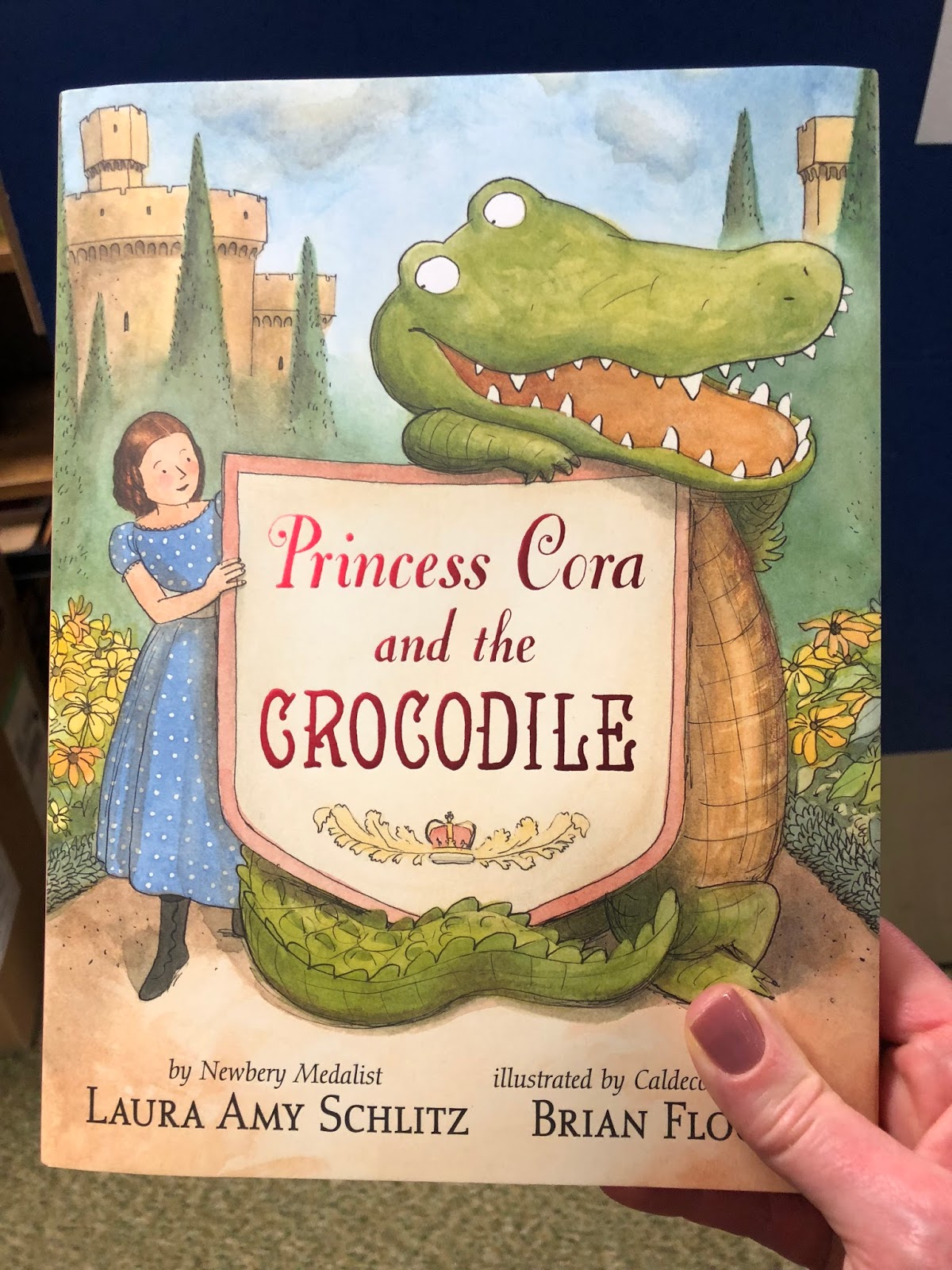
Princess Cora is overwhelmed.  Her parents love her so much and want her to be successful, so they fill her day with the things that are most important to being an excellent princess and queen - taking baths (a queen must be tidy), studying (a queen must be intelligent) and physical activity (a queen must be strong).  Cora often tries to suggest to them that they're over doing it, but they don't listen.  One day, Cora has had enough and she writes her fairy godmother a letter, asking for help in the form of a pet.  Cora wants a dog, but her fairy godmother has other plans.  She sends Cora a crocodile, and a naughty crocodile at that.  Hilarity ensues, and eventually (after a little gnawing from a crocodile dressed like a princess) the king, the queen and the nanny all realized that Cora does need a bit of a break.
This is a great book with a kind of sad twist to it.  At first, none of the adults even notice that it's not Cora but a crocodile - they are all to wrapped up in "worrying what might be wrong with her". And every minute of every day is planned around training for Cora by the time she is seven years old.  I enjoyed the story when I first read it for it's absurdity and silliness, but as I think about it more, I can't help but see some parallels in the way we currently raise and educate our children.
Are Schlitz and Floca trying to subtly tell us something?  I recently read an article about the life lessons found in Chinese children's literature vs. children's literature in the United States, and it got me thinking about how what we read shapes our beliefs and thoughts.  I can't help but wonder who will benefit more from reading this book - children who might learn that it's OK to play and to ask adults for what we need, or adults who might need to be reminded that kids need to be kids.
In any case, the book is absolutely worth the time for readers of any age.


27 January 2018

The Journey of Little Charlie by Christopher Paul Curtis

The Journey of Little Charlie
Christopher Paul Curtis
Scholastic Press
Release Date: Jan. 30, 2018
order it from the Tattered Cover here

My favorite book of all time is The Book Thief by Markus Zusak because it was the first book I'd ever read that gave the German perspective of the Nazis during WWII .  It opened my eyes and I connected very quickly with the idea that not everyone who lived in Germany (in fact a very small number of Germans) actually sympathized with the ideals of the Third Reich.
I know, it's a weird way to start a book review by talking about how much I loved another book...but stick with me.  Christopher Paul Curtis has done the same thing with The Journey of Little Charlie.  Told from the point of view of the not-so-little Little Charlie Bobo, this is the story of slave catchers in the 1850s who would travel north to try and recover escaped slaves.  The story opens with the sudden death of Little Charlie's father and the discovery that his father apparently owed money to a man named Cap'n Buck.  Cap'n Buck says that the only way Charlie can pay off his father's debt is by helping him recover "stolen property".  Little Charlie has never left his home of Possom Moan, South Carolina and though he's tall and looks like a full grown man, he's only 13. Along the way Little Charlie discovers the true character of Cap'n Buck and though he doubts he should be helping the Cap'n at all, he sees no other way proceed.
This would be a great book to use when teaching character evolution - the changes in Little Charlie are both obvious and inferred, which is perfect for upper elementary literary analysis.
I also learned to love the way the book was written.  Curtis writes it the way that Little Charlie would say it (much like the Aibileen Clark chapters from The Help). I struggled at first because I was reading it from a teacher's point of view and I wasn't sure how well students would be able to read it and understand what he was saying.  However, by the middle of the book, I was used to it and loved Little Charlie's voice, and I think students will too.  It would make a great read aloud if the reader was willing to get completely into it.
I would highly recommend this book to teachers and students and plan to give it to a student who loved Elijah of Buxton on Monday and see what she thinks of it.

Once again, thank you to Kristen Gilligan of the Tattered Cover for providing me with awesome ARCs to read and review.

26 December 2017

Just Like Jackie by Lindsey Stoddard

Just Like Jackie
Lindsey Stoddard
HarperCollins Children's Books
Release Date: Jan 2, 2018

It's been awhile....
Like four years. Whoops. It's not like I stopped reading or anything - in fact, I'd say the opposite.  And just recently I was given the opportunity to read and review some ARC (advanced reader copies) from a local book store.  The one condition to getting the free ARCs is that I must review the ones I particularly like.  So I figured why not review them here as well.  You know, dust off the ol' blog and get back at it!

Cover art courtesy of HarperCollins
Just Like Jackie is an amazing story. If you enjoyed Fish in a Tree by Lynda Mullaly Hunt, or Counting By 7s by Holly Goldberg Sloan, you will love this book.
Robbie Hart was named after baseball great Jackie Robinson, even though she's nothing like him.  Robbie wishes she could stay calm under pressure, but usually it just boils up and right out of her - like the time Alex Carter called her a motherless bird and she punched him in the face.  He may have deserved it, but when the principal calls Robbie's grandpa into school, she knows there will be trouble.  Robbie's grandpa is having trouble remembering things lately and she's afraid people at the school will find out and blame her.  She knows that if she would just be a better student, then grandpa's memory could rest and his word's wouldn't get confused.
This is an amazing story that, like Counting by 7s and Fish in a Tree is told from Robbie's point of view.  I really love these books because it gives kids a chance to hear their own voice in a novel.  In fact, while I was reading it, I couldn't help but think of a couple of kids at our school who would benefit from reading this book.
I can't help but wonder though, how much of the inferred meaning do kids get out of books like this?  When I read it as an adult, I know that grandpa's memory issues have nothing to do with Robbie's behavior at school...but will a 10-year-old know that when they're reading? And then I wonder - does it really matter? And the answer is no, not really.  I believe deep in my core that if a reader gets lost in a story, then the story has served its purpose, and it is not our place to decide whether or not the reader inferred enough depth of meaning from the story.  I've read the same book (The Book Thief by Markus Zusak) countless times, and each time I read it, I find something new to love and cherish about the story.  That's what makes a book great - one that you'll read multiple times and continue to lose yourself in it, love it, and learn from it. Just Like Jackie has the potential to be that kind of book for kids and adults alike.

08 October 2014

Haiku Book Reviews

As a teacher, I know that what I do for my students each week has purpose and meaning.  I intend for every lesson to stretch their minds, grow their learning and help them become the amazing people they will become. I plan, prep, think, re-plan, re-prep and re-think lessons before I teach them.  After I teach them I think about how it went, did they learn what I intended them to learn?  Did they grow?  How can I make the lesson better?  What can I tweak to get just a little more out of my students?

It's exhausting.

And sometimes, I plan lessons that absolutely flop.  I'm human.  It happens.  All teachers learn to deal with lesson flops. But other times, I hit student-centered-learning pay dirt.  And when that happens, it's awesome.

Recently, I saw a post on Jennifer Reed's blog about people who made a difference in 17 syllables and thought it was genius.  I also happened to be working with our 6th grade team on how to best implement our new writing curriculum.  Our 6th graders struggle with using "vivid" words, so we decided to apply the 17-syllable idea to book reviews.

First, I made sure students understood what a haiku was and how the format of 5 syllables, 7 syllables, 5 syllables worked.  Then they brainstormed words to describe their books.  That was all we had time for in our first 30 minute session.  I looked at the descriptive words they'd come up with and circled the words I felt could be more "vivid" - replacing "boy" with "young man" etc.  I really wanted the kids to think about synonyms and the meaning behind some of the words they chose.

The next week we worked on boiling our books down to two or three themes or lessons from the books they chose.  Then, the worked on the writing of their actual haikus.  The teachers and I were blown away with the amazing ideas they came up with!

Here's where the lesson absolutely took off. The kids floored us with their ability to come up with great haikus!  The teachers even got so into writing haikus that they created an instagram account to share their haikus with one another.  Originally, I wanted the students to use animoto to create short, quick animotos for their reviews - much like what Mrs. Reed did with her students.  However, using a free app called Color Cap, we were able to have the students create visual representations of their haikus in about 20 minutes.  The classroom teachers then published the haikus to their instagram account, and I was able to download the images and add them to our Kyffin LMC Book Blog.

Here are some of the amazing Haikus our 6th grade students created:


30 September 2013

Dragonborn by Toby Forward

Dragonborn
Bloomsbury
2011

In my time as an elementary librarian, I've learned that dragons are awesome*.  Kids LOVE dragons.  Heck, adults love dragons.  At my local library, there are over 277 books about dragons.  And that's just at one branch of the library.  When I search all branches of the library for the entire county, we're talking thousands of books (okay, so just a thousand, but still).  So when I'm shopping for books, any books that are about dragons get put in the cart and read as soon as they come in.

I was pretty excited when Dragonborn finally came in.  It looked perfect for elementary - cool cover, not too thick, but not too thin, etc.  Turns out, looks can be decieving.  I think.  I'm not certain yet.  Lemme 'splain.

First, a summary:  Sam is a wizard apprentice to the great wizard Flaxfield.  At the beginning of the book, Flaxfield dies and Sam must oversee his "finishing".  All the wizards who completed their apprenticeship under Flaxfield begin to return, and they doubt Sam's abilities and they even begin to doubt whether or not he really was an apprentice.  Sam, who has really only ever known life with Flaxfield, fears that these adult wizards plan to send him off to the coal mines to work and decides to run away with his pet dragon Starback. His adventures lead him to a wizard college and to the mines that he is so afraid of.  All the while, an evil...person? being? someone of indeterminate species... named Ash is after Sam...I think.  It seems that Flaxfield trapped her, and her creepy unexplained companion named Bakkmann in a tower somewhere and if they can get Sam, they can get out.  There are also roffles (they seem like dwarfs, but I'm not certain) and memmonts (no idea really - maybe they're cats?) and all kinds of other magical things that inhabit Sam's world that are explained only through excerpts from Sam's apprentice notebook.  Oh yeah, and dragons.  I almost forgot the dragons.

Was that summary odd?  Well, it makes sense because the book is rather odd.  The excerpts from Sam's apprentice notebook are meant to connect things together and to give background information, but often end up confusing the reader.  I went back and re-read the excerpts often, trying to make sense of the story line through the excerpts.  But usually, that didn't help.  The chapters and sections that relate to Ash and Bakkmann are just as confusing, but end up making sense at the end of the novel, even if they don't answer all the questions they raise at the beginning.  The book is clearly written to be part of a series, I'm just not certain its written well enough to encourage readers to read the rest of the series.

However, I'm an adult, and I read books very differently than my students.  There have been books in the past that are similar to Dragonborn that I didn't enjoy and my students LOVE.  Since the book is written for young readers, I think I should reserve my judgement about the book until I can get an expert opinion or two about it.  So I'm going to book talk it this week, hope someone checks it out and then ask their opinion.  I promise I'll report back if I can.

In the meantime, I would recommend this book to any young reader interested in fantasy, mystery and dragons.  The reading level places it at a 4th grade level (at least), and I think students up to 7th grade would enjoy it.

*I couldn't help myself.  That video is so unbelievably random and weird, it's awesome.  Also, I bet that guy is single.

05 September 2013

Chomp

Chomp
by Carl Hiaasen
Alfred A. Knopf
2012

I've loved Carl Hiaasen since I read the very first page of Skinny Dip (read it, you'll agree).  I love his sarcastic wit and well-woven plot lines.  When I became a teacher librarian and found out he also writes books for young readers, I was excited and nervous.  Not many writers can write well for multiple ages (case in point: LOVE James Patterson books for young readers, can't stomach his adult novels).  However, Hiaasen nails it.

Chop stars two fantastic young people: Wahoo and and Tuna.  The only two kids on the planet named for fish (granted, Wahoo isn't named for the fish - he's named for a professional wrestler).  Wahoo's dad is a wild animal wrangler.  Tuna's dad is...not so great.  When Wahoo's dad is hired to help out with a survival show Expedition Survival, Tuna decides to tag along, especially since the host of the show - the famous Derek Badger - is her personal hero.  Tuna quickly finds out that Derek Badger (who is referred to not-so-affectionately by Wahoo's dad as "Mr. Beaver") is not the survivalist he claims to be on the show.  And when Badger goes a little crazy and wants to start doing all his own stunts, things get messy quick.  Wahoo and his dad can't back out of the job - they need the money, and Tuna doesn't want to go home, so they're stuck trying to make the best of a difficult situation.

As always, Hiaasen's dry humor and plot twists turn the book from just another book to an absolute page turner.  And I appreciate the fact that the relationship between Wahoo and Tuna never turns romantic - it would have been too cliche.  Wahoo's love for his family and his animals, and his desire to help Tuna are genuine and completely age appropriate.  And Hiaasen's portrayal of adults is also age appropriate: they are flawed but not to the point of being disrespectful.

I would highly recommend this book to anyone who thinks Bear Gryls is a bit much.  Ok, seriously, I would recommend this book to any one who likes survival stories (both wilderness survival and tough-life-situation survival), any middle-grade student looking for a fun read, and any parent who wants a great book through which they can connect with their child.

30 August 2013

Spy School

Spy School
by Stuart Gibbs
Simon & Schuster Books for Young Readers
 2012

I picked up Spy School for two reasons.  First, it is  a Colorado Children's Book Award Nominee this year, and second, a student checked it out last week and came in two days later saying "Ohmygosh, Mrs.Covington this book is AMAZING howhaveyounotreadityet?!?!"

I didn't have an answer, and I didn't have a book to read that night, so I took it home. And I'm glad I did!  It's a great read - just enough suspense to keep me reading, along with some truly humorous moments.

Ben Ripley is a 12-year-old dork.  There's no two ways about it.  When he comes home from school one day to find out he's being recruited for the undercover CIA spy school, he's overjoyed.  Finally, he'll be able to do something cool.  Unfortunately, it's all top secret - he can't even tell his best friend.  However during his first day at spy school, after being shot at a few times and fighting off an attacker in his dorm room with a tennis racket, he finds out that he actually didn't qualify for spy school - they brought him in to use as a decoy to flush out a mole within the school.  Luckily for the CIA, Ben is actually smarter than he seems and he turns out to be a pretty good agent-in-training, especially since his life is on the line.

While the plot is extremely fantastic, and I was a little annoyed with how absolutely inept every single adult in the book was portrayed, Spy School is a fun read.  And though I'll admit I figured out who the mole was before the book actually revealed it, I will say it took some re-reading and deep thinking for me to actually figure it out.  I would say this book is a great read for anyone between 4th and 7th grade - depending on their reading level, and it's a great read for any kid who likes spy novels.

08 August 2013

One Big Thing

At the beginning of last year, my library was visited by one of the district big-wigs, a man named Matt Corimer, who, it turns out, is not only brilliant, but kind, funny and awesome to work with.  When he visited a year ago, we had a discussion about transitions and how difficult it can be to take over a library that has been run by someone else for years.
Earlier this summer, I talked a little about weeding and how difficult (and entertaining) it can be.  Taking over a library can also be difficult - there are processes and practices in place that may or may not fit who you are as a librarian.  In my conversation with Matt last September, I started to get a little riled up and overwhelmed at all the things I needed to change and do and fix.  Matt - being the calm dude he is - simply said "My best piece of advice for you is just choose one big thing."  He went on to explain that there's only so much we can do in any give time period, and if we try to do everything, we'll sink.  So he suggested choosing one big thing each year.  The idea resonated with me, so I decided to try it.

Last year my OBT (yep, I just went there) was implementing weekly lessons when classes came in to the library.  As much as I love my job, I miss actually teaching.  So I decided to combine my love of teaching with our school's (and really most school's) very real need of teaching kids the how of finding.  How to find books, information, resources, facts, etc.  The results were fantastic.  For one, I was able to get my "fix" of teaching. While I didn't limit my teaching to these mini-lessons (I always made myself available to teach more   in-depth, curriculum centered lessons, usually in the afternoons), through this system, I was able to stretch myself professionally by trying different lessons, and I now have a rough skeleton of a "library curriculum" that outlines which skills to teach at each level, and those skills spiral throughout the grades.  Secondly, the teacher's loved it.  And I mean, they loooooved it.  I heard several times that the lessons made library time more enjoyable for them and their students, and they felt that their students were actually utilizing more of the library independently (can you hear my heart singing? That's one of the best compliments a librarian can get). Speaking of which, I really think the kids got quite a bit out of it.  Yes, there were classes and grades that moaned and groaned about it - mostly because I'd taken away their precious "computer searching" time.  But for the most part, the kids were engaged in the lessons - especially if I was doing book talks.  I am amazing at book talks.  And that is the fourth benefit I saw from my weekly lessons: I got to do regular book talks.  I love doing book talks! My library is full of amazing books, but it's impossible to assume that students will know which books to read, so giving quick book talks is always a great way to encourage them to try something new, or to show them a book they didn't know existed in the library.

As of today, we're in a new school year, which means I need a new OBT. I've decided that this year, my focus will be on technology and building a staff and group of students who are independent technology users. Last year we had nine computer carts that I was expected to manage. NINE.  That's 135 computers.  It was an impossible task.  Carts would go missing, classes would keep them longer than they'd sign up for them, not to mention the everyday maintenance.  Last year, I brought the issue to the technology committee and they came up with the idea of breaking the carts up and distributing them throughout the classrooms.  The PTA agreed to purchase newer computers, which gave us the numbers to be able to put three laptops in each classroom, and have 60 computers that can be on carts and used as class sets.
There are always challenges when you change a system.  I know it will be a difficult adjustment for many some of the staff because now they will be responsible for the three laptops in their classrooms.  But that's where my OBT becomes an OBT.  I hope to provide them with the access to the necessary resources to be self-solvers and solution finders.  I will, obviously, support them in any way that I can, but I can imagine that there is going to be some push-back as I encourage them to be independent.  And it truly is my goal to lead them to being independent users of technology, and for those who view themselves as "non techies", or un-techno-savvy, it is my hope that by the end of the year, they will believe that they are smarter than the computers in their classrooms.  If I can instill confidence in them, I will have done my job.

Wish me luck!
S

What We Found in the Sofa and How it Saved the World

What we Found in the Sofa and How it Saved the World
by Henry Clark
Little Brown & Company
2013

I know, you're probably starring wide-eyed at your computer in utter shock that I'm actually writing a book review.  It's shocking to me as well.  Let's see if my old brain* can remember how to compose a thoughtful, coherent book review...here goes!


cover art courtesy of Follett Titlewave.com
Three friends, River, Freak and Fiona, wait together for the bus every morning.  One day they find a sofa at their bus stop.  They can't figure out where it came from, but they're curious.  They decided to search the couch for lost change and they find a few interesting items: a double-six domino, a double headed coin, and a rare zucchini colored crayon.  They discover that the crayon is actually worth quite a bit of money and decided to auction it off online.  And thus begins their adventure, where they discover that their seemingly dying town of Cheshire and the now "dead"area of Hellsboro are actually the center of an evil genius' plot to  take over the world. Along the way they learn about each other - until now their friendship has been somewhat superficial - and themselves and how living on the edge of Hellsboro has shaped their lives and brought them to this exact moment.
The story line is creative, and Clark embeds so much learning in the book - everything from chemistry to history - and he does it seamlessly.  Young readers will learn so much from this book without knowing they're learning.  I can see students wanting to learn more about various subjects because of this book.

I truly enjoyed this book. I stumbled across it thanks to Amazon.  During my first year working in an elementary library, I realized that my library is focused on books for beginning readers (k-2) and intermediate readers (5th & 6th grade).  My poor 3rd & 4th graders have very little they can read in the library.  So this summer I concentrated on trying to find books that fit their needs.  What We Found is almost one of those books.  I'd say this book is about perfect for 4th grade or an advanced 3rd grade reader.  It covers all the difficult topics: being bullied, feeling left out, trying to fit in, and doing the right thing. And it covers all these topics with equal parts of humor and brevity.  I would recommend this book for just about any student 4th through 6th grade, and for their parents - it would be a great dinner conversation piece.

Happy Reading!
S

*Totally typed "brian" there.  Yep, my brian (brain) is officially old.

18 July 2013

The Truth about Weeding

For my non-library readers, weeding is the process of removing old beaten-up or non-circulating books from the collection.  It's a task that every librarian dreads but must do.  I dread weeding for multiple reasons.  For one, it's not easy.  Mostly because books are disgusting.  People touch them with their grubby hands, sneeze on them, and heaven knows what else (remember that episode of Seinfeld?).

But on a more serious note, there is no perfect formula for knowing which books to keep and which books to get rid of.  Sometimes I'll pull a book off the shelf that I'm certain no child has touched in the last thirty years and when I go to remove it from my system, I find that it was checked out 15 times last year.  Now, if a book is over 50 years old, it gets weeded (yes, I've found books in my current library that are over 50 years old.  I swear.).  If it's truly popular or it's a classic, I'll replace it, but super old books have to go.  In any case, whenever I weed, it always becomes a long process of evaluating the needs of my patrons, the quality of the books (not the exterior quality - the quality of writing, information, etc.) and that fantastically annoying dilemma of weighing the value of having the information in print versus online.

My current library hasn't been weeded ever in probably ten years.  It seems like there's been some dabbling, but no truly thorough weeding.  This is mostly because no librarian has stayed in this library for more than 3 years in the last 10.  However, I plan to be here for the long haul, so it's weeding time.  I wash my hands probably 80 times a day, my brain hurts from alternately laughing out loud and the books I find and truly wrestling with books that I'm not sure about, and I'm fairly certain I've been exposed to germs that have been incubating in books for years.  This post doesn't include any pictures because my library is a DISASTER, and I'm afraid exposing my camera or my iPad to books that old would cause a black hole to open up in time.

But boy have I found some treasures!

Today I found a book about Walt Disney that was written in 1953 and hasn't been checked out since...I don't know when (my computer system doesn't go back that far).  I also found a first edition of The Island of the Blue Dolphins. It's missing the jacket, but that little gem has been tucked into my office where it will stay protected forever.

The truth of the matter is, I won't be able to get my entire library weeded before the start of the school year. However, now that I've started, I'm pretty sure I can weed in sections through out the year, and then next year I can develop a 3-5 year weeding cycle that I can maintain for the rest of my time here.  For now, I think my break-from-weeding-to-blog has lasted long enough.
Back to the trenches!

15 July 2013

So it's been a year...

I'm quite certain most of the 9 people who regularly read my blog have given up on me, as I basically gave up on blogging about a year ago.  But for the 3 of you who may still be checking my blog, here is a quick run down of what has happened since you last heard from me.
1. I read Days of Blood and Starlight, it was amazing.
2. I got engaged.
3. I started a blog for the two of us.  It's awesome, but I let it fall by the wayside as well.
4. We bought a house.
5. Somewhere in there, I realized that my new job was awesome and beyond challenging, and my time prioritites shifted.  I still read (and do read) every evening, I just chose to spend what free time I had with my soon-to-be husband instead of blogging.
6. I was given permanent status at my new job (wahoo!)
7. We got married. It was perfect.

Next thing I know, it's been almost a year with no book reviews at all.  I thought about closing down shop permanently, but this summer I've read such fantastic books, that I just can't yet.  So I'm going to try again to blog regularly.

Today, I'm going back to school.  Voluntarily.  If you aren't a teacher or someone who works in schools, this phenomenon of "voluntary work" might baffle you.  See, even though we teachers get summer vacation, very few of us actually take it.  There is so much to do in the course of a school year that it's nearly impossible to get it all done during the 8 hour days that we're technically paid for.  Especially when 7 of those ten hours are filled with students.  So most of us spend at least a portion of our summer working to get caught up and ready for the coming school year.
So as soon as I finish my delicious tea, I'm headed in to work in my library.  And you know what?

I can't freakin' wait.

Happy Monday!

06 November 2012

I'll be back later...

Today is the day my friends.  The most important day of 2012.

Yes, we'll elect a president today.

Yes, today I'll find out whether or not I have a job next year.

But more importantly, this happened....

IT'S FINALLY HERE!!!
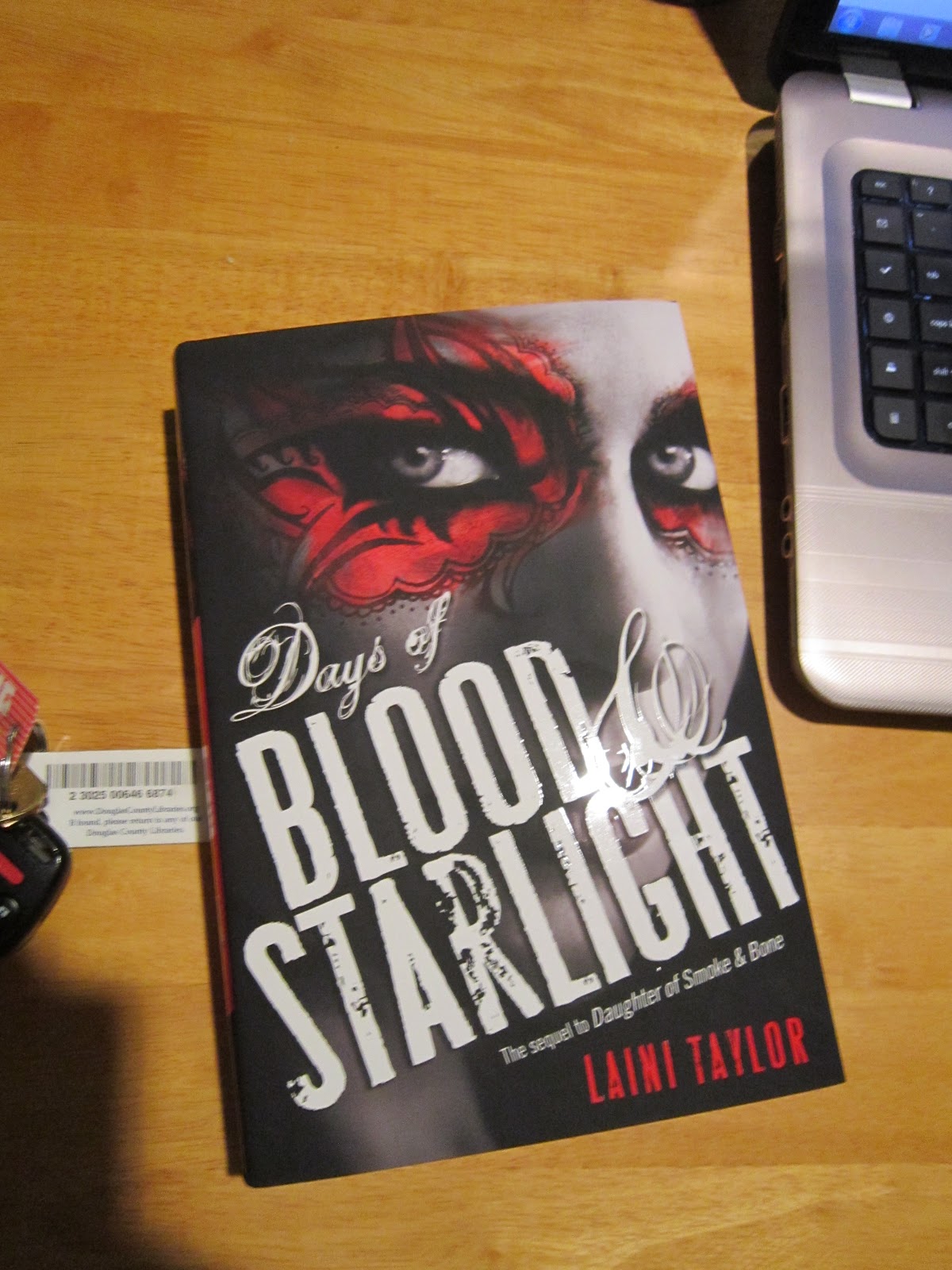
The long awaited, truly begged for, sequel to Daughter of Smoke and Bone.

See you in a week when I finish it.

Oh, and Laini Taylor, if you're reading this, I already know I'm going to need an advanced copy of the next one please.  Please?!?

24 October 2012

Proof that librarians are wicked smart

At CALCon this last week, my friend Sarah and I noticed a fascinating trend...

saucy brown leather
Dansko shoes.  Lots of them.


hello there Mary Jane!
 Don't assume Danskos are "librarian shoes".  I've seen teachers, doctors, and sales people wearing Danskos.
patent brown leather
So why is this significant?  Well, according to their website, Dansko shoes are carefully constructed to "promote good foot, leg and back health".  My feet agree.

You see, librarians don't just sit behind a desk all day.  Whether we work at a public, academic or school library, we are on our feet helping patrons basically all day every day.  In between patrons, we usually rush back to our office/computer/cubby to answer a few quick emails, add a few tasks to our to-do list, and if we're lucky, cross one or two things off that ever-growing list.  So it's extremely important that we wear shoes that are good for our legs and backs.  That, and Danskos are fashionable (if my sister reads this blog, she will laugh out loud).  No, they aren't Christian Louboutins, but NOWHERE on his website does he claim to care about the health of anyone's gams.  At the other end of the footwear spectrum are these bad boys, and while I'm certain they're very good for your legs, I wouldn't call them fashionable.

So as you can see, we librarians prove our smarts by choosing footwear that is both comfortable and not crazy looking.

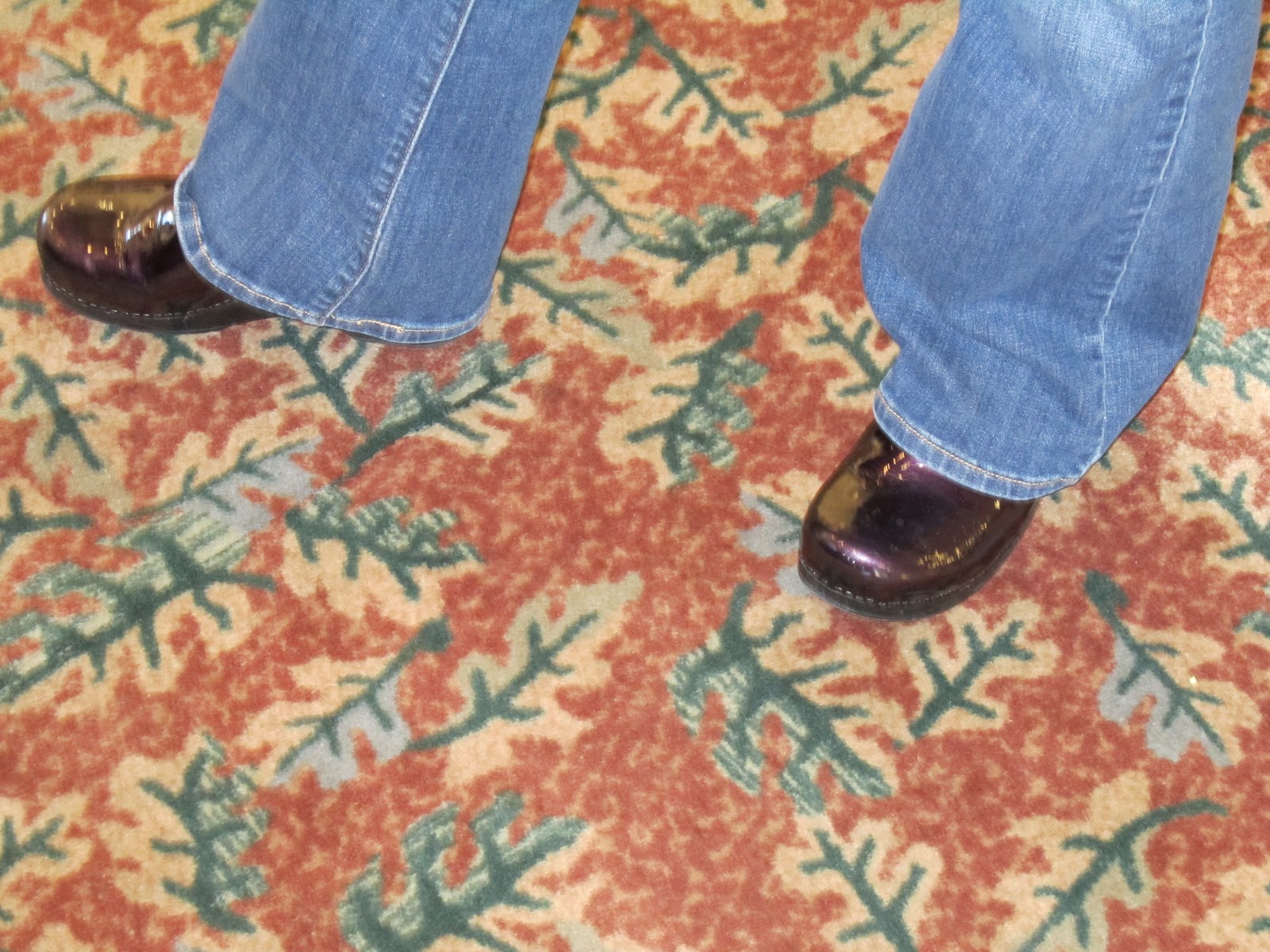
Though some of us do get a little crazy and wear shiny purple shoes...
ohh la la

23 October 2012

Geek Fest...I mean CALCon 2012

I say "Geek Fest" with the utmost respect for my fellow librarians.  I realize that ninety percent of all professional conferences come with their own level of "geekness" - librarians speak a different language than, say, surgeons and accountants.  And when large groups of accountants, surgeons or any other profession get together, they tend to speak their own language and get REALLY excited about things that are only exciting to their particular professional area.  I imagine that at an accounting conference, people discuss tax laws heatedly, and at surgical conferences there is a buzz and excitement about the newest piece of surgical technology.

For me, the Colorado Association of Libraries 2012 Conference (CALCon) was especially geek-tastic.  Not because of the other conference attendees, but because of two of the keynote speakers.  I completely and utterly geeked out when I was able to meet one of my favorite bloggers and one of my favorite authors.

Jack Gantos has been publishing books since 1976.  He writes picture books, children's books, YA lit and adult books.  He's funny, quirky and smart.  He's like the Johnny Cash of the literary world - minus the scary mean side.  His novel, Dead End in Norvelt won the Newberry Award last year, and it is fantastic - funny, inspiring and meaningful.  I can't think of a single student who wouldn't love this book.
See?  We're bffs.
He spoke on Saturday and it was inspiring.  He talked about how he writes, what inspires him and why librarians are important.  I laughed so hard I almost peed.  But most of all, I loved hearing him speak because he brought a voice to the main character from Dead End - Jack.  In fact, I didn't realize it until I heard him speak, but Dead End is his childhood (with some wonderful twists).

Explaining how "librarians are like constellations"

Gantos also does school visits where he teaches creative writing.  He explained that writing really isn't that difficult.  There are two steps:  figuring out what you want to say it, and then figuring out how to actually say it.  However, since most students can stare at a blank piece of paper and just wish the words would appear, he often encourages them to draw a spy map of their house.
The spy map of the Gantos home
Drawing a map of the house from the perspective of a spy encourages students to open up their imaginations and think of all the possibilities for interesting, fun stories.

Gantos saved all the journals he's written since 5th grade - and he explained that many of the ideas for his books come from things he wrote in his journals over the years.

The other person I had the honor of meeting and hearing speak (twice) was Bobbi Newman.  She's a firecracker - and not just because of her hair.  She truly is a library innovator: she maintains a blog called Librarian By Day that always tackles and faces big library issues (intellectual freedom, access, the changing face of libraries), and she has a great voice.  She's funny and inspiring.  I'm a huge fan.

My library hero
Newman gave a keynote speech as well as lead a breakout session.  Her keynote speech tackled the idea that innovation might be scary and uncomfortable but it's necessary for libraries to maintain relevance within a community.  I enjoyed her keynote speech, but I loved her breakout session.  There she discussed the importance of digital literacy and transliteracy, and the myth of the digital native.  All of which are extremely important to libraries, librarians and anyone who works with the internet.  At least they should be...

Completely enthralled
So you can see, a three day conference turned into a totally library-world-celebrity-geekfest for me.  I also got to spend three days with two of my very favorite librarians:  my best friend from childhood Sarah and one of my mentors, super librarian Becky.  These two women inspire me daily, and I'm so thankful I got to hang out with them, learn with them and be inspired by them.

Now let's see if I can apply all the fantastic information and ideas to my everyday library world.

24 September 2012

Emory's Gift by W. Bruce Cameron

Emory's Gift
W. Bruce Cameron
Forge
2011

If you happen to be one of the four people who know me and have not had to listen to me go on and on about the amazingness (it's a word) of A Dog's Purpose, then stop reading this post and read this one and then come back here.
If you aren't in the mood to blog surf, I'll just spit it out for you:  W. Bruce Cameron has written a book that changed my life.  I am a dog lover (not an animal lover necessarily, but definitely dogs) and A Dog's Purpose changed the way I view the mortality of the dogs I've loved in my life and why I keep the stinky little mutts around.
While at the library a few weeks ago, I decided to look for other books by Mr. Cameron, and that's how I came across Emory's Gift.
While the two books are very different, Cameron has a distinctive writing style that is enjoyable to read, and he definitely has a knack for plot twists.
Emory's Gift is about a thirteen year old, Charlie, and a grizzly bear, Emory.  Charlie's life hasn't exactly been a walk in the park - his mother recently died of cancer and his father is struggling to keep it together.  When you add the fact that he's in middle school, well, you can imagine how much life just sucks.  One day while fishing in the stream behind his house, Charlie not only sees a grizzly bear, he pretty much feeds the bear the trout he'd caught.  A few days later the bear writes the name Emory in the sand, and Charlie realizes that this bear is special, but he wants to keep Emory a secret.  Eventually, it is clear that Emory doesn't want to be kept a secret, and Charlie and Emory embark on an unbelievable adventure.
By the end of the book I could not read fast enough and could not put it down.  Cameron weaves a beautiful tale of adolescence, family and growing up in a small town.  However the ending? Meh.  Don't get me wrong, it wasn't bad - it was actually quite good.  I was just expecting something more moving - the ending of A Dog's Purpose stuck with me long after I finished the book.
All in all, Emory's Gift is a great read - definitely something to pick up before going on vacation or a great read for a rainy weekend.  Unline ADP, I don't think it's necessarily an all-ages book.  It's more violent and I'm pretty sure it has a few four letter words.  I'd recommend it for middle school and older, and to anyone who loves the outdoors and the idea that the unimaginable is possible.

Happy Reading!
S

Confessions of a Grammar Ninja

I will openly admit that I'm really not a grammar ninja, but more of a grammar czar.  I choose not to use the term grammar Nazi - for one, I hate that term, and for two, I won't kill you if you use bad grammar, but I might try to banish you to Siberia.

Why this post today?  In a ten minute time span, I saw three different instances where people used then instead of than.  I was unaware that these two words were so difficult!  I get that people confuse there, their and they're, your and you're, accept and except, but then and than?  They aren't even homophones!

If you don't have to google the word homophone to continue reading this post, I love you.

Every morning when I wake up, I commence an inner battle: correct or not correct. As a teacher, I live in a very odd little world.  When I'm with students, it's my job to help them become productive, world citizens who don't sound like this guy.  When I was a classroom teacher, that was no problem - I spent the majority of my day working with kids, and since they're kids, I could correct their grammar with patience (usually) and understanding because they are/were kids -usually not old enough to vote or know who they wanted to be in twenty years. However in the library things are different (I bet you think you know where this post is going...I promise unless you know me well, you don't, so keep reading).

Now that I'm a librarian, I not only don't have as much time to help students with their horrific grammar and super smart comments, I am now often surrounded by adults with horrific grammar and super smart comments.  Back when I was teaching German, I could go DAYS without having to converse with or listen to dumb adults, now they come into my office looking for help all. the. time.  I spend most of my day helping adults with technology or listening (with a forced smile) to their opinions about books, libraries and the Dewey Decimal System (yes, we still use it. No, I don't know the exact number and classification for the random book you currently hold in your hand. No, I don't think it's outdated and I DEFINITELY don't think the IPAD CAN REPLACE A LIBRARY.  Sorry...rant over).

These days, I feel like I can handle the "super smart" comments with much more grace and patience than I can terrible grammar for two main reasons:  1. it's election season and everyone makes dumb comments about the candidate they adore/abhor. 2. Our media makes us stupid.  Don't even get me started - just watch as many episodes of The Newsroom as you can and we'll probably be on the same page. Love. That. Show.

But I'm still having a hard time with the grammar.  How is it possible that our generation grew up on grammar drills (sentence diagramming anyone? I loved that shit!) and most of us insist on using the word irregardless (I once heard a woman say "irregardlessly" and my head almost exploded)?  How can you be allowed to vote in this country if you say things like "Where's my phone at?" and use words like "excape" and "supposibly"?


Sometimes I'm pretty convinced that an intervention might be the only thing that can save me, but then I catch a glimpse of myself in  the mirror and remember that I'm so far from perfect, I really don't have the right to correct anyone...ever.  So I will continue to correct my students, and when I feel like it will be well received (a word I have struggled to spell correctly my entire life), I will gently correct my colleagues, friends, and family members.  Though I will say I have learned that correcting my sister's grammar will result in a sore arm from her punching me as hard as she can, and correcting my handsome guy's grammar will result in a deluge of nonsensical grammar-diarrhea that will make my head spin.

Just do me a favor: please remember that the words are disregard and regardless.  That's all I ask.


21 September 2012

Library Lesson: Tabletop Twitter

Not until I started teaching elementary, did I realize that technology can actually be limiting sometimes.  Now that I have no students old enough to use things like Facebook and Twitter, I'm faced with an interesting challenge:  teaching them to be responsible online citizens without violating COPPA.  It's not terribly difficult, but to maintain my "cool" image and teach them online responsibility is a bit of a challenge.  Yes, I could stick to the elementary friendly websites, but let's be honest, sixth graders are so over coolmath4kids.com.
Whilst perusing some of my new favorite websites for great library lessons, I came across this fantastic post about table top twitter, and I decided to give the idea a try.  So I created a lesson that taught my 6th grade students a quick history of twitter as well as the purpose of the at symbol (@) and hashtags (#).  Then I put a sheet of butcher paper on each table and asked the students to tweet either a response to the prompt or use the hashtag phrase in a tweet.  Usernames were decided simply by using first name and last name initial, and the students then completed a walkabout* that lasted about ten minutes (one minute per table to write and respond and some movement time).

The muffins LOVED IT!  They came up with some great tweets, and the teachers were completely enthralled (I didn't know that none of the teachers use twitter).  The best part of the lesson was the final result: they came up with some excellent tweets, responded to one another thoughtfully, and (most important in my book) didn't think the activity was "dumb" or "boring".

Here are some of their fantastic tweets (sorry the second one is difficult to read)

In response to the question "What advice would you give younger students about the library?" MylesR gave this great advice:

DuncanJ had great advice, and then MadelynR not only had a great response (@), she also made up her own hashtag that started popping up everywhere (man those little muffins are resourceful!)

Good lord I love it when my lessons are successful!

Happy Teaching!
S


*in a walkabout lesson, participants are broken up into groups and rotate through "stations" where they are asked to respond to prompts, questions, look at data, solve a problem, etc.  The stations rotate relatively quickly, and once every group has rotated through all the stations, a quick debrief/share out is done.

11 September 2012

Do Unto Otters: a Book About Manners by Laurie Keller

Do Unto Otters: A Book About Manners
Holt
2007

Let me start off by saying teaching Kindergarten is an absolute trip.  I have NO idea how regular classroom teachers handle those little - albiet adorable - bundles of pure energy for basically 7 hours a day.  Kindergarten was definitely the grade that I was the most afraid of teaching.
Now that I have four weeks of "elementary teaching" under my belt, I realize it's fourth graders you want to avoid (I jest...mostly...).
There are two things that I find awesome about Kindergarten and two things that drive me batty.  Here they are:
Drive Me Batty:
1. the fact that most everyone refers to them as "kinders".  The German word for children is Kinder and I constantly want to correct people's grammar until I realize that they would have NO idea what I was talking about.  So far, I haven't corrected anyone, but just wait for the day that I am super tired and cranky.
2. All. The. Singing.  Ohmylanta they sing all the time.  There's a little Kindergarten song for every occasion of the day.  So far, I've abstained from the singing.  I just watch the teacher as she sings, trying to keep the smile on my face and the nausea at bay. (I know it's mean but I can't help it!  12 years of high school will ruin you for things like singing, clapping and sitting in circles)
Pure Awesome:
1. Their unrestrained JOY for library time and all things book.  When those little people - those Kinder if you will - come in to the library it truly becomes Magorium-esque and magical.  They may not be able to read the books, but by God they WILL check them out and they WILL spend hours "reading" them.  It's awesome.
2. Storytime.  I now love storytime.  I get to read the COOLEST books to the Kindergarteners.  One of the best I've read so far is Do Unto Otters by Laurie Keller.  Our first Kindergarten unit is on civics, rules and government.  So I found this book and read it to them and not only does it explain manners, it's HILARIOUS.  It's like a Pixar movie: it has everything the kids need and some entertainement for adults as well.  Two of the three times I read it during storytime I started laughing!  Twice because I noticed something new, and once because a little boy (the first one to notice it)  noticed the page where the otter passes and says "excuse me" and loudly exclaimed "The otter tooted!"
This book is not just for Kindergarten - you could read it to just about any elementary age - older kids can learn phrases in different languages (there's please, thank you and excuse me in five languages) and they can learn about play-on-words.  The younger ones can discuss manners and how we should treat each other.  The illustrations (done by the author) are wonderful, though it is quite busy for the little ones - there's a lot to see on each page.

It's an amazing book and I'd highly recommend it to anyone who has or works with younger children.

Happy Reading!
S

10 September 2012

Long overdue update

Yes, I am still alive.
Yes, I'm terribly sorry I disappeared for, what, 3 months.
Yes, I have OODLES to tell you.
Yes, I've read some amazing books.
And again, I'm sorry I disappeared with no warning.

Here's the story.  See the cute boy in this picture?  He's my guy.  He's my dream come true, my knight in shining armor (cheesy but true).  The only bad part is that until July, he lived 4 hours away.  So this summer was spent moving from my home in western colorado to OUR home in the Denver area.  I can honestly say I've never been happier or more fulfilled in my personal life.
The only downside is that I had to leave a job I loved and most of my immediate family behind in order for us to start our life together.  I'm not worried about leaving my family anymore - I still get to talk to my mommy-lein and my sister regularly, and we're planning regular trips back for visits.

My job situation is a different situation.  Part of the reason I have not blogged about my job situation is because I wasn't sure I'd enjoy where my career was headed.  I have switched from a mid-sized school district in a fishbowl community to one of the largest school districts in the country in a very large city.  I've worked in big districts before and enjoyed it. 

However, I'm also working with a new age group: elementary students.  Those two words - elementary students - gave me the shivers until recently.  Don't get me wrong, I think they're cute, but the idea of teaching them?  Shiver.  That wasn't ever in the plan- it wasn't supposed to happen.  I'm a high school teacher for the love of Pete.  I work with students who don't want to go to school and think they know what cool is, not with small munchkin-like beings with snotty noses who want to hold my hand (ehhh...the germs!)
However, God makes the decisions He makes, and now - a mere two years after leaving the high school realm - I am the teacher librarian at a school in the Denver area.  No, I don't love it yet, but after three weeks with students, I can honestly say that I just might.

So for those of you who have enjoyed reading my blog so far, I want to warn you that there are some changes coming.  Being in the elementary library is an adventure, and since my little brain can't handle running more than one blog, I'm going to continue blogging about the amazing books I'm reading and I'll be blogging about my experiences in the world of elementary library science - the lessons I teach to my students as well as the lessons I learn from them.

I hope you enjoy the new direction my blog is taking.  If not, I'll completely understand if you choose to read other, better blogs about things that interest you.

Happy Reading!
S
06 June 2012

Best. Blog Post. Ever

If I had a nickle for every time I've been asked "Have you read Fifty Shades of Grey?", I'd have about $2.  It doesn't seem like much, until you remember that we're talking nickles.  It's gotten annoying.
There are many reasons I'm really not all that interested in reading this book, and I'll admit, I often shy away from super popular books.  Why?  Because I figure if they're THAT popular, they're probably good, so I don't need to read them (I'll admit, I only read book one of Harry Potter).
However, in the case of 50 Shades, I just don't think I'd like it.
Don't get me wrong, I love smut novels - they're fun to read - but this seems like it's a higher level of smut, and I'm really not currently in the mood for more-than-smut.
I could continue listing the reasons I'm not going to read the book, or I could just direct you to this amazing blog, where the blogger lines out some awesome reasons for not reading the book.


I mean, why reinvent the wheel?  And, she's much funnier than I am.